

The Life and Adventures of Santa Claus was the end of an era for the Rankin/Bass Studio. It would be the last holiday special produced using their special brand of stop-motion animation, which they dubbed “Animagic.”
 This comforting style was, of course, responsible for such beloved TV favorites as Rudolph the Red-Nosed Reindeer (1964) and Santa Claus is Comin’ to Town (1970), and with The Life and Adventures of Santa Claus, that age so familiar to generations came to a close.
This December marks the fortieth anniversary of The Life and Adventures of Santa Claus, which makes it the perfect time to revisit this Rankin/Bass special – and thank you to reader Nik Kramer for suggesting it!
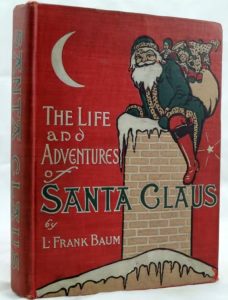
Based on a 1902 book by none other than author L. Frank Baum, well-known for creating the beloved Oz books, who crafted an intricate origin story for Santa in The Life and Adventures of Santa Claus.
With so much detail in the book, writer Julian P. Gardner (a pseudonym for Jules Bass, who also wrote the lyrics for the songs) had to truncate the story when adapting it for the one-hour special. As it opens, Tingler the Imp (Robert McFadden), a character created for the special, informs the Supreme Immortal, The Great Ak (Alfred Drake), that the Immortals of the world are coming to the magical Forest of Burzee for the meeting that The Great Ak called.
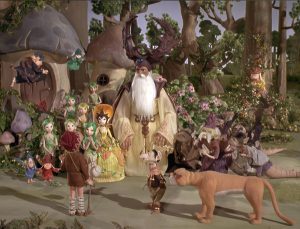
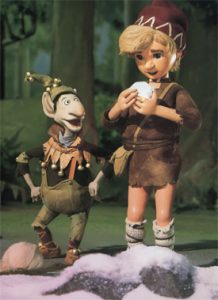 At the meeting, The Great Ak informs the Immortals that Santa Claus, a mortal who has shown the world great kindness, is on his last Christmas Eve travels and will, sadly, face death after. It is proposed to the others, by The Great Ak, that Santa be made an Immortal, and to convince the group, he tells the story of how Santa came to be.
Sixty years prior, a baby was found by Ak and placed into the care of the lioness Shiegra and eventually adopted by Necile, the wood nymph (Lesley Miller), who names him Claus, a name used in the forest for little one.
When he grows into a young man, Ak takes Claus to visit the mortal world, where they are invisible but can observe. Here, Claus is shocked by people’s cruelty and the suffering it causes others.
He questions Ak about mortals and is told they’re here to make the world better than they found it, which becomes Claus’ purpose. He determines that he must live among the mortals, leaves the forest, and sets up a home and workshop in the “Laughing Valley of Hohaho.”
He rescues an orphan child, Weekum (Joey Grasso), for whom he makes his first toy, a wooden cat. This leads to making toys for other children in the village.
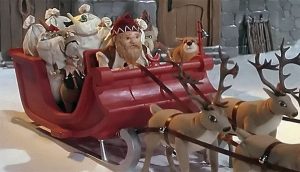 One day, a note tied around a rock is thrown through his window. The threatening note reads: “Mr. Claus, if you make another toy, we are coming for you. Signed King Awgwa.” The Awgwas, who can make themselves invisible, are ugly, troll-like creatures who influence children to do bad things.
Claus defiantly decides to continue his toy-making, and the Awgwas attempt to kidnap and capture him, but he receives aid from the forest creatures, the Knooks. While deliveries, the invisible Awgwas constantly ambush him and steal the toys.
Claus decides to try delivering the toys at night, is ambushed again, and is saved by Shiegra. After this, Ak meets with the Awgwas, warning them not to harm Claus, and war is declared. A battle follows between the Immortals and the Awgwas, in which the Awgwas are defeated, and Claus is free to deliver his toys.
 To assist, he is given flying reindeer from Peter Knook (Peter Newman), a mythical fairy, and when he gets to the first house, he finds it locked and must use the chimney, and places gifts in the children’s stockings left by the fire to dry.
The next morning, Claus is called a saint by one of the children’s fathers, which the kids interpret first as Saint Claus, then Santa Claus. After Claus returns, it’s decided by him and Peter Knook to limit the trip to Christmas Eve.
Concluding the story of Claus, we return to Ak at the table with the Immortals, who vote to bestow the mantle of immortality upon Claus. As the special ends, Santa Claus thanks the Great Ak and says, “For in all this world, there is nothing so beautiful as a happy child.”
Directed by Jules Bass and Arthur Rankin, Jr., The Life and Adventures of Santa Claus is a much different special for Rankin/Bass, despite it being told in their familiar “Animagic” style. The character design, particularly of the Immortals, has none of the more cartoony tone of the Studio’s previous work, but instead is more dramatic and striking.
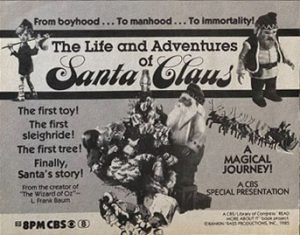 When the special debuted on December 17, 1985, on CBS, critic John O’Connor wrote in his New York Times review: “Much to its credit, this version of the Santa Claus legend gets away from the jolly old St. Nick routines and those busy little workshops run by adorable elves.” This is a good note for Rankin/Bass fans who haven’t seen The Life and Adventures of Santa Claus. While Santa’s name is in the title, there’s very little Christmas in the special, instead focusing on the high-fantasy fable of how he came to be. It’s also not connected to the sunnier, Mickey Rooney-voiced origin story and sequel, Santa Claus is Comin’ to Town (1970) and The Year Without a Santa Claus (1974) that audiences may be more familiar with.
The story itself is also darker in tone, from the fact that it opens with Santa’s potential demise, to the stark scenes, such as when young Santa witnesses starvation among many mortals and the Awgwas unleash fierce creatures during their battle with the Immortals. In his book, The Enchanted World of Rankin/Bass: A Portfolio, author and Rankin/Bass historian, Rick Goldschmidt wrote, “This special is not the usual happy fanfare that Rankin/Bass has been associated with in years past. This is probably due to the fact that they were trying to recreate the images of Baum’s book and didn’t want to repeat any of their past efforts.”
While not as well-known as the other, famed Rankin/Bass holiday specials, consider The Life and Adventures of Santa Claus as part of your Holiday viewing, to celebrate the holiday season, its 40th anniversary, and the end of an “Animagic” era.