
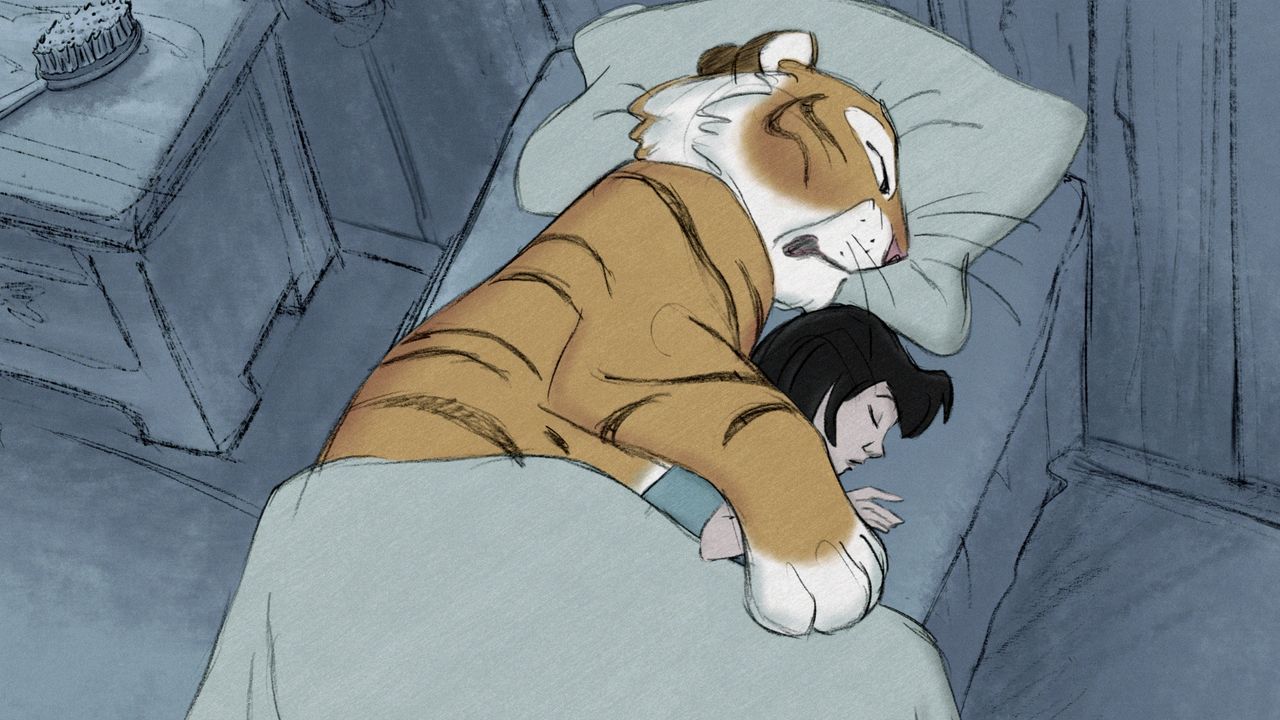
The 28-minute long animated short, Mushka, was actually completed in 2023 and premiered at the San Francisco International Film Festival, but it’s just recently been released to streaming. Mushka is the brainchild of Andreas Deja, a Disney animator with over 30 years of experience. It’d take too long to list all the movies Deja has worked on, but most notably, he supervised the animation for Scar in The Lion King, so it’s only natural he’d work on a short film about a tiger. This is a bit of a departure for Deja, being an independently produced short without the backing of Disney money or a huge animation team. It’s a passion project, and it totally works.
 A young girl named Sarah is sent to live with her father after her grandmother is hospitalized. Her move from Ukraine to Russia comes with more than simple culture shock. Her father (who is still mourning for Sarah’s implied to be dead mother) has trouble connecting with her, and he lives in a world of a dreary miner. Sarah is friendly with a neighbor boy, but she doesn’t find a bright spot until she meets a tiger cub. The miners shoot the tiger’s parent, so Sarah takes it upon herself to raise the cub, whom she names Mushka because of the “M” pattern on his fur. As expected, taking in a wild animal causes problems, especially when Mushka becomes fully grown. Things get even worse when the miners set their sights on profiting off Mushka like they did his parent.
This short proves that there’s still a place in the world for classic, hand drawn animation. A team of only 20 or so animators crafted this charming short. The designs are all distinctive and paint the characters perfectly. From Sarah’s joyful innocence and her father’s rundown gruff demeanor to the miners that check off every box on the list of visual cues for shady dudes. The real draw, of course, is the tiger, and he is wonderful. Mushka’s design leans more towards the anatomy of a real tiger than an exaggerated cartoony one. There’s real weight to him, too, as he slowly moves his shoulders and leaves pawprints in the snow when he walks. The “M” in his fur on his forehead is distinctive, and he goes through a wide range of emotions while not breaking any rules when it comes to animal behavior.
The limited animation actually works to Mushka‘s favor. Sure, the characters look like they  are barely out of animatics and there’s still some visible rough lines on them, but it’s not distracting. The shading and even the color is enough to add depth to the film. Sometimes cartoons that are too polished look like they’re trying to distract from something or even overcompensate. Mushka doesn’t try to hide anything or use animation as shortcuts to storytelling. Angles are used very well. Sarah is a small child, and even Mushka’s eye level isn’t high like a human being’s, so we see a lot of low angle shots. Scenes tend to linger, too, letting the emotion settle without any abrupt shifts.
If there’s anything about the overall look that doesn’t quite work it’s some of the backgrounds. The warmth of the interiors contrasting the cold desolate Russian exterior is fine, but the woods lurking just past the fence don’t feel like they are a vast forest where tigers can be found. At one point, Sarah has a dream where she’s riding Mushka, and it’s entirely without a background. Granted, it’s a dream and it’s allowed to be kind of surreal, but showing just our two main characters surrounded by white isn’t really a striking visual.
 Deja shares writing credit with Michael McKinney, and I imagine a lot of the plot came out in developing the animation. You can’t fit a whole lot of plot into 28 minutes, but you can certainly evoke emotion. It’s a story about a lonely girl who, unable to connect with her family, befriends a wild animal that ultimately can’t stay with her. You can pretty much guess the beats of the story, but that doesn’t make it any less endearing. Sarah and Mushka’s relationship hits all the right notes, ranging from heartwarming to even unsettling at times. You’re never worried about her physical well-being, but her emotional well-being is certainly at stake. I’m surprised at how much sympathy I felt for her father, who ends up being far more lenient with her than your average father simply because he wants her to be happy.
The storytelling really lies in the visuals, but the voice acting is fine. Sarah is played by Helena Aviv Perez, who I believe is an actual child, which is always appreciated. The cast is so small that the miners are all played by one guy. Considering one of the characters is a tiger that can’t speak and his body language does a lot of talking, the dialogue isn’t all that important. It probably translates very well into other languages and, given how moving the music is, you can almost watch it just with the score dictating the scenes. Fabrizio Mancinelli is credited as the composer, and the late, legendary film composer Richard M. Sherman (of the Sherman Brothers) composed “Mushka’s Lullaby”, the main title theme, in one of his final roles. “Mushka’s Lullaby”, which is beautifully sung by Holly Sedillos, is a haunting tearjerker.
Andreas Deja’s Disney background definitely shines through. Just look at the special thanks at the end to see the kinds of people he has rubbed elbows with. At the same time, nothing about this short screams Disney (except for the Hidden Mickey that’s snuck in at one point). Mushka is a small, independent labor of love. It’s great to see a seasoned professional like Deja strike out on his own and produce something like this. It really raises the bar for animated shorts and gives less experienced animators something to aspire to.
Mushka, produced by Andreas Deja, Craig Peck, and Roger Viloria, has won several awards for Best Animation during its film festival run. It’s available on all streaming VOD platforms, and the original score has been released by Lakeshore Records.
The post Review: “Mushka”: An Animated Short-Film Delight appeared first on Anime Superhero News.