
Over four decades later, “Boys Don’t Cry” remains one of The Cure’s most immediately recognizable songs. Rooted as much in early-’60s pop songwriting as in the emerging punk and post-punk movements of the late ’70s, it favors concision, clarity, and melodic directness over atmosphere or sprawl. Written in 1978 and released as a standalone single in June 1979, separate from the band’s UK debut Three Imaginary Boys, its undeniable catchiness set it apart early on—already distinct from the darker, more elastic directions The Cure would soon pursue.
That melodic simplicity gives the song its emotional leverage. Boys Don’t Cry turns on vulnerability under pressure, framing heartbreak through self-restraint rather than release. The lyrics follow someone taught to keep feeling contained, even as it pushes back against control. That friction—between what is expected and what is felt—quietly establishes the band’s early emotional terrain, outlined here with clarity and economy.
The song’s broader recognition came later, particularly in the United States, where it appeared as the title track on the American edition of Three Imaginary Boys in 1980. College radio embraced it. Touring carried it further. Over time, it settled into the group’s core repertoire, an early statement that continued to resonate across decades.
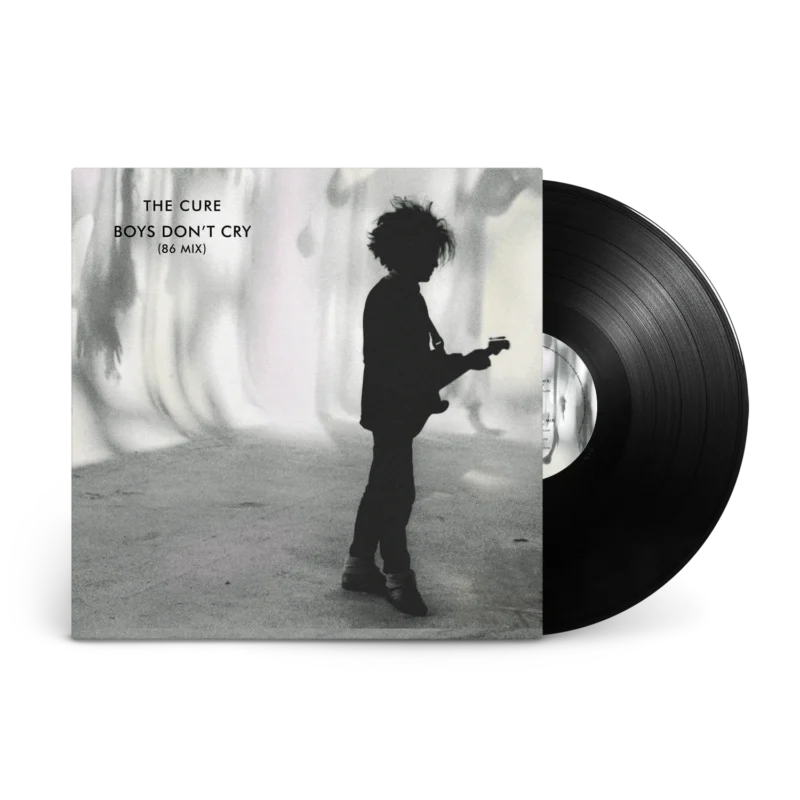
That sense of distance between origin and afterlife became explicit in 1986. During sessions connected to the singles compilation Staring At The Sea – The Singles, the song was revisited, with the vocal re-recorded and the backing track subtly reshaped. Although the revised version, originally billed as New Voice, New Mix—now issued as Boys Don’t Cry (86 Mix)—was created to promote the compilation, the album itself retained the original recording, leaving the new mix confined to its original 7-inch release.
This 1986 music video mirrors that same sense of temporal dislocation. Instead of showing the current band performing, it depicts the original trio—Robert Smith, Lol Tolhurst, and Michael Dempsey—as literal “boys.” Child actors mime the song against a constructed backdrop, representing the debut-era lineup. Behind them, separated by a translucent curtain, are silhouetted figures of the adult band members, their eyes glowing with fluorescent paint. Even though Michael Dempsey left shortly after Three Imaginary Boys, he is visually reintroduced alongside Lol and Robert.
That continuity extends to the song’s visual identity. The single’s sleeve uses a variant image from the Andy Vella shoot that also produced the Boys Don’t Cry poster, a photograph that became ubiquitous in goth teenagers’ bedrooms throughout the 1980s and beyond. Drawn from the same session, the sleeve image reflects how the song’s presentation circulated and endured alongside the music. Now, that chapter enters wider circulation. To mark the song’s 40th anniversary, Boys Don’t Cry (86 Mix) is being released digitally for the first time. The anniversary edition brings together the original 7-inch mix alongside the 12-inch version, accompanied by remastered B-sides Plastic Passion, Pillbox Tales, and Do The Hansa. All tracks have been remastered by Matt Colton.
Pre-order the single here.
Follow The Cure:
The post The Cure to Release 1986 Version of “Boys Don’t Cry” as a Single for 40th Anniversary appeared first on Post-Punk.com.