
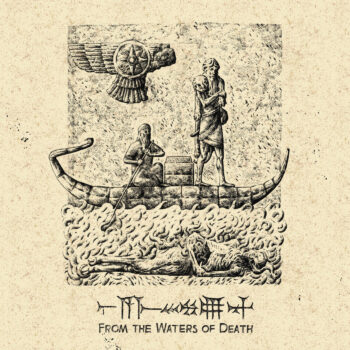
 In case you’re unfamiliar, The Epic of Gilgamesh is an ancient Mesopotamian poetic narrative, whose first complete form is dated to approximately 1800 BCE. It follows a story of King Gilgamesh and his dealings with gods and other mythic monsters, culminating in a journey for the secret of immortality.1 What better way could there be to consume this rich, literary epic than have it interpreted by the collection of artists behind From the Waters of Death? Obscure black/doom duo Swords of Dis; death metal veteran and experimenter Serpent Ascending; Neptunian Maximalism’s darker, heavier incarnation Ôros Kaù; and ambient-black dreamer Midnight Odyssey. All are infamous—if you know who they are—for their strange, unconventional styles and love for long-form expression that borders on the self-indulgent, which may make them ideally suited to a Gilgamesh retelling. You may already be experiencing a sinking feeling of dread at those name-drops. But together these artists achieve something that exceeded my expectations even as it met them squarely.
While appearing to be a split, Waters is more of a collaboration as each individual contributes vocal or instrumental talents across multiple songs, including on those they wrote and take the lead in themselves. Spearheading the whole thing are Richard and Alice Corvinus of Swords of Dis, who have a hand in all lyrics and appear on every track. These lyrics, inspired by the words of the epic itself, consist of narration interspersed with dialogue between the various characters, and the five musicians rotate and share roles depending on who is involved in the corresponding part of the story. 2 This improves the album’s internal coherence—which might otherwise be hindered in a split format—whilst also allowing each movement to take on the personality of its lead artist. As a form of adaptation, the five tracks of reverb-filled, noisy, strange, melodramatically or demoniacally vocally-led, black-adjacent fringe metal lean into the grand, frightening side to the tale whose gravity us modern-age folk probably can’t appreciate properly. And it’s that excessive, almost absurd commitment to being different, which—and I can’t believe I’m saying this—actually works.
Drama is at the heart of oral poetic tradition, and it’s Waters’ drama that similarly grounds its best aspects. Utmost credit goes to Alice Corvinus and her fierce (“From Egalmah They Rode…”3, operatic (“Araru Births the Lord of the Wilderness,” “From Egalmah…,” “Blood Stains The Altar…”4), sometimes eerie (“Into the Wailing Darkness”5) vocal performance. Her presence dominates as she provides some narration in addition to voicing every female character (and there are a lot of goddesses involved). Dark, minor tremolo refrains and Middle-Eastern-inspired melodies support her delivery, and the theatrical, flowing style Swords of Dis employ lends itself to this expression perfectly. In a different vein, the inhumanly gurgling snarls of Guillaume Cazalet (Ôros Kaù) make for a barbed contrast to otherwise vague, even beautiful, passages (“Blood…”), and can be genuinely frightening (“Into The Wailing Darkness”). All vocals—clean or harsh—are odd to a degree, sometimes even off-putting (“Araru…”). Yet most breaches of the cringe line are brief, and ameliorated by interesting instrumentation (“Blood…,” “From the Setting…”6). Those totally averse to what we anaemically refer to as ‘avant-garde’ in extreme metal can beg to differ, but the back and forth between dissonance and harmony (“Araru…,” “Blood…”), and between uncomfortable slowness and sudden speed (“From the Setting…”), is not only well-performed, it makes sense for the record’s narrative concept. A journey represented through a monotonous pattern (“From Egalmah…,” “From the Setting…”), the fury of a deity by means of an operatic surge (“From Egalmah…”).
Waters embodies the manner of epic poetry so well, however, that its digestibility is harmed as well as helped. Whether appropriate or not, its near-90-minute runtime makes engaging with its entirety a daunting prospect, and this is a record that fares best when you do give it the time and space to immerse you.7 The very aptness of the compositional style—long repetitive sections on the one hand, and frequent switches between tempo, melody, and vocalist on the other—which mimics recitation amongst orators, can prove taxing. It creates a dynamic of brilliant moments and stand-out performances, scattered unevenly inside overextended filling. It’s perhaps not a coincidence that the album’s midsection—the two tracks led by masterminds Swords of Dis—is by far the best and most even in quality, whereas its final act—Midnight Odyssey’s—is the least engaging and unable to support its length.8
Though Waters cannot escape the idiosyncrasies of the artists behind it—and so inherently restricts its audience—as an expression of this epic poem, these approaches to black metal are surprisingly apt. If you have the time to go on this adventure with Serpent Ascending, Ôros Kaù, Swords of Dis, and Midnight Odyssey, there’s plenty to enjoy. But if nothing else, let it be an excuse to learn about the original myth that inspires such weird, sometimes wonderful music.
Rating: Good(!)
DR: 6 | Format Reviewed: 256 kbps mp3
Label: I, Voidhanger
Websites: Album BC | Serpent Ascending BC | Serpent Ascending FB | Ôros Kaù BC | Ôros Kaù FB | Swords of Dis BC | Swords of Dis FB | Midnight Odyssey BC | Midnight Odyssey FB
Releases Worldwide: February 13th, 2026
The post Swords of Dis, Serpent Ascending, Ôros Kaù, Midnight Odyssey – From the Waters of Death – A retelling of the Epic of Gilgamesh Review appeared first on Angry Metal Guy.