
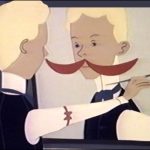
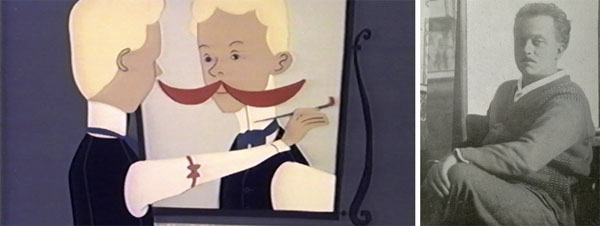
Of all of the segments on The Boing Boing Show, no short had more of a complex production than “The Invisible Moustache of Raoul Dufy.” The film was an idea of Sidney Peterson’s to introduce children to the famous painter Raoul Dufy, whom many of UPA’s top artists admired. While it was a well-intentioned cartoon short, it caused legal trouble with the Dufy family. The short had a history at the Museum of Modern Art and was BAFTA-nominated.
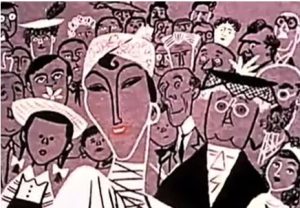 In Adam Abraham’s essential book When Magoo Flew, Abraham describes the tone and material of The Boing Boing Show as ranging from “imbecilic to the arcane.” He goes into great detail about the history of the series and talks a bit about this short, referring to it and others written by Sidney Peterson as the most sophisticated shorts on the series.
Before discussing the short, it should be noted that the UPA style was incredibly influenced by Raoul Dufy. In Jules Engel’s oral history conducted by Milton Zolotow, Engel mentions Dufy’s influence on the UPA style several times. I think Engel’s interview with Zolotow is one of the most important oral histories of any animation talent ever done. With the transcript alone being over 600 pages, it’s an essential reference. Engel, in his over 9-hour interview, talks about how Dufy was influential in the UPA style’s “divorced line,” by which he meant that UPA’s films tried to avoid separating the characters from their backgrounds and designs. Dufy’s design was particularly influential on UPA’s adaptation of Madeline.
The Invisible Moustache of Raoul Dufy was one of the shorts that aired on the first episode of The Boing Boing Show. The other segments that appeared on the first episode were “A Horse of Course,” “Miserable Pack of Wolves,” and the original Academy Awarding Gerald short from 1950. The idea for the short came from Avant-Garde filmmaker and ex-Disney talent Sidney Peterson.
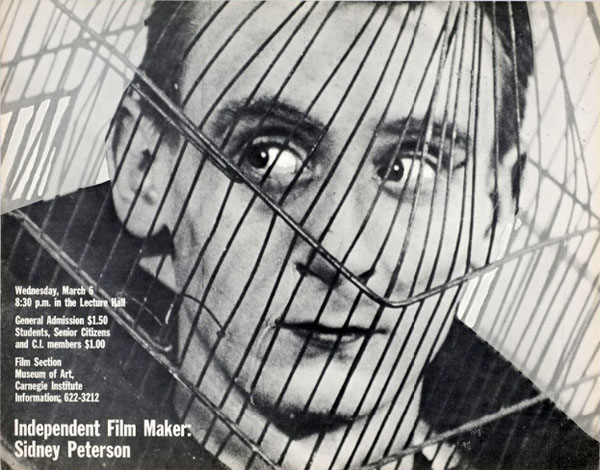
Poster for Sidney Peterson’s appearance at the Carnegie Institute featuring his film The Cage on the cover.
Sidney Peterson developed the Raoul Dufy short as part of The Museum of Modern Art’s Television Project. Peterson wanted to develop a children’s film about artists, and this is what The Invisible Moustache of Raoul Dufy was intended for. The Rockefellers funded these cartoons. Adam Abraham pointed out that there was meant to be more films that Peterson had intended to be at the MoMA. However, the Raoul Dufy short was the only film commissioned by MoMA. It premiered in its television exhibit.
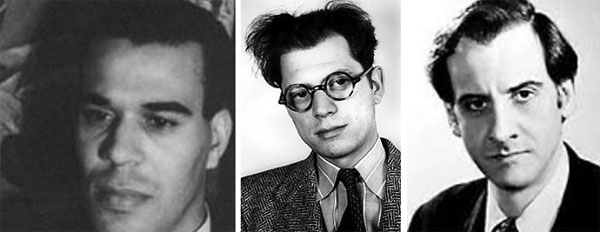
(From left to right), writer and developer Sidney Peterson, director Aurelius Battaglia, and the film’s narrator Hans Conried.
Revolution of the Eye: Modern Art and the Birth of American Television stated that “The Museum of Modern Art remained ambivalent about the Television Project throughout its three-year existence.” As ambivalent about the exhibition as they were, MoMA was even less impressed with the short Peterson and UPA had developed and soon abandoned Peterson’s future projects. According to Berger, the museum demanded that the short be removed from the project because they found that the short did not “further the cause of modern art.” To learn more about the MoMA Television Project, I highly recommend this digital exhibit, available here.
After this short, UPA did two other artist-based shorts, “The Merry-Go-Round in the Jungle” and “The Day of the Fox: A Legend of Sharaku.” Both of these, along with Dufy, were part of the series that Peterson had developed for the Television Project called Meet the Artist. However, MoMA only funded the Dufy short.
The film was directed by Aurelius Battaglia and narrated by Hans Conried. Battaglia’s design and direction is very evident in the film. Battaglia grew up in Washington DC and was the son of Italian immigrants. From 1937 to 1941, he was an artist at Disney, and during WWII, he was a theatrical caricaturist for the New York Tribune. He worked on The Boing Boing Show throughout its run and later became a children’s book illustrator. Battaglia also drew on Dufy’s style and repurposed his paintings for the cartoon.
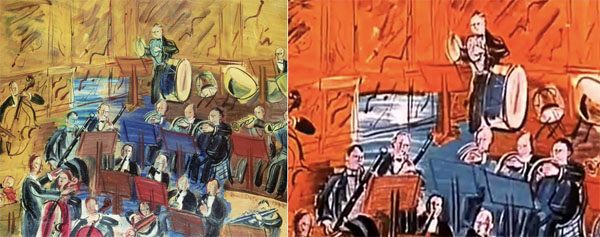
On the left is the original Raoul Dufy painting, The Orchestra (1942), and on the right is the painting as represented in the cartoon.
The Raoul Dufy short also caused a bit of legal questioning. At the time, UPA was one of the only animation studios to have its own in-house lawyer. That lawyer at the time was Dixon Dern. Dixon is currently retired after a lifetime of being one of the top lawyers in the entertainment industry. His first job in a Hollywood studio, though, was at UPA. The Television Academy of Arts and I have both interviewed Dixon before. In the rest of the article below, I’m using my own conversations with Dixon and their interview. The TV Academy Interviews are often very lacking in substance, but Michael Rosen did a good job with this one. The full interview can be listened to here.
A native of Colorado, Dixon Q. Dern graduated from Stanford Law School in 1953. After finishing law school, Dern stayed at Stanford to teach legal writing and turned his legal focus to intellectual property law. After establishing his own firm in San Jose, he flew to Los Angeles to meet Dick Hungate, who was then representing UPA. Dixon would be hired from there as the in-house attorney. He was hired due to the influx of new legal issues regarding The Boing Boing Show. Dern would stay on staff for 18 months. The cartoon he most remembered was this film about Raoul Dufy.
About the short, Dern said, “After we saw it, we realized that we probably would have to get permission from his widow to show it anywhere outside of the United States because of French international property law.” This was due to the French laws of moral rights. Moral rights in French law state that the heirs of an artist will determine how an art piece is represented. Dern and the UPA staff found a gallery owner who spoke French and knew Dufy’s widow. Even though Dern couldn’t speak French, he understood from the phone that Dufy’s widow was strongly opposed to the project. Dern continued: “So we went ahead anyways and delivered it to CBS with the recommendation that it is not shown in France.” Regarding whether or not Dufy’s widow could retaliate with a lawsuit, Dern said, “Our feeling was that she couldn’t here in the United States, but we didn’t know about anywhere else.” Despite this fear of being shown outside of the US, it was nominated for a BAFTA.
Regarding his time at UPA, Dern told me on the phone that he enjoyed working there and told the TV Academy, “I learned a lot, and I really learned animation.” He spoke in depth about his involvement at the studio, as well as the founding of the Academy of Animation Arts. After UPA, Dixon would go on to become one of the most significant lawyers in the entertainment industry and has been referred to as “The Godfather of Entertainment Law.” He went on to represent the biggest organizations and people in the industry, including the Television Academy of Arts & Sciences, Bob Hope, Desilu, and CBS. Despite this, though, Dixon never really left the world of animation. He would continue to represent many in the animation industry, including Fred Calvert, Film Roman, and, in particular, Chuck Jones.
In 2009, Dixon was awarded the Syd Cassyd Founders Award for his many years of legal service to the Television Academy.
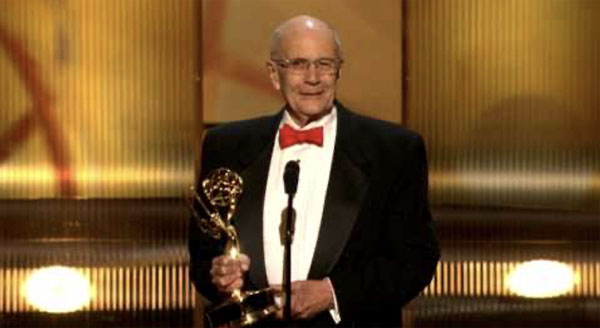
Dixon Dern winning The Syd Cassyd Founders Award (link to the award presentation here.)
Special Thanks to Dixon Dern for his recollections.
Also special thanks to the helpful texts and interviews written or conducted by Maurice Berger, Milton Zolotow, Adam Abraham, Cinzia Bottini, Michael Rosen, and Karen Herman.
And additional thanks to Mike Kazaleh, Jerry Beck, and Strummer Cash Petersen.