

All right. You’ve all forced my hand. I too remember when bullfighting cartoons were suggested as a topic during my first weeks of composing columns for Animation Trails. I at first considered the subject as too long, well in excess of a single article, to tackle at the time, until my writing began to expand to multi-article series. I’d kept the subject in mind as a future fall-back reserve, even contemplating expanding it to all things bovine, beyond mere bullfighting to other films spotlighting cattle (things like MGM’s and Disney’s respective films, “Home on the Range”, or Avery’s classic “Drag-a-Long Droopy”). But last week, interest turned to the subject in a two-part article from Dr. Toon. I waited until both posts were completed, thinking that if anything was left over, I’d drop it in via a footnote reply. But wait, said I, as, after reviewing the accumulated contributions of the author and the readership, I realized that the number of additional, unmentioned titles on the subject seemed to merit discussion surpassing the page length of the original two articles themselves. With the indulgence and good graces of Dr. Toon, who got things well-started in covering most of the higher spots in theatrical animation, I feel the need to temporarily shift gears away from my current series, “Get With the Times” (which I shall resume to conclude, after a few weeks), to provide in these columns a supplement to the “That’s No Bull” duo, intended to fill in the gaps, including not only many television outings not addressed by the readership, but, especially this week, several classic theatricals deserving mention, a select few of which might be considered groundbreakers.
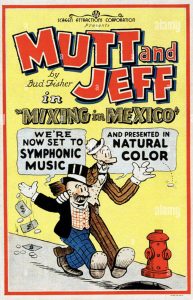 To begin with, some clarification appears necessary concerning the contributions of Mutt and Jeff to the subject. Dr. Toon referred to an episode without title from 1922, while some of the readership seemed to interchangeably banter-about the titles “The Bull Fight” and “Mixing in Mexico.” This confusion appears to stem from a home movie edition of “Mixing In Mexico”, which erroneously retitled the film as “The Bull Fight”, and has circulated widely on the internet. However, this cartoon was produced in 1925. The real “The Bull Fight” was their last release in 1922, and, while no print of the film is yet known on the internet, it seems to exist (posted in the holdings of the Library of Congress), and a title card bearing a release credit to William Fox has surfaced on a Mutt and Jeff Wiki. However, even the Wiki is confused, as it follows the image with stills from an amber-colored print (while the Fox card is not tinted amber) which obviously derive from the familiar “Mixing in Mexico”. By the time of “Mixing In Mexico”’s release, the Fox distribution had ended (earliest prints currently known of episodes from this period give distribution credit to “Film Distributors Ltd.”) So the located title card is real, while the stills from the cartoon are not. “The Bull Fight” is not the only unaccounted-for Mutt and Jeff possibly touching on the topic subject, as their 1918 filmography also includes the presumably-lost “A Lot of Bull” and “Throwing the Bull”, while 1919 titles include “The Cow’s Husband” – a title Max Fleischer would reuse during the Talkartoon days, as observed in a reader’s reply last week – and “Mutt and Jeff in Spain”. As I’ve observed on prior occasions, how much we may have lost in tracking the true origins of classic animation gags and tropes from the loss of such a large percentage of the Mutt and Jeff archive.
It also appears that Happy Hooligan was not the first to appear in a bullfighting cartoon. An earlier release date goes to Krazy Kat’s “Throwing the Bull”, released 2/14/17. (Don’t hold your breath until anyone comes up with a surviving copy.) There is also the possible candidate, “A Bum Steer”, from 4/1/28. Also, “Torrid Toreadors”, from 4/27/29 – possibly released with music and effects track.
To avert further confusion, it came as a surprise to me that an Out of the Inkwell cartoon from Fleischer which I had assumed was on-subject, “Koko Baffles the Bulls”, revealed itself to have nothing to do with either bulls or bullfighting upon viewing. The slang “Bulls” was intended to refer to detectives, whom Max sends out to investigate the disappearance from the drawing pad of Koko and Fitz. This same slang would reappear in animation about thirty years later, in the name of a one-shot character from a late Terrytoon, Clancy the Bull (a canine detective), in a film entitled, “Police Dogged”.
 The seemingly endless library of Paul Terry’s early work includes one, perhaps two titles in this category. There is the unaccounted-for “Spanish Love” from 1926, extant prints of which are said to exist on 16mm and VHS, but no copy of which appears to have reached the internet. The definite is All Bull and a Yard Wide (10/9/27). A rather short cartoon which meanders a bit in storyline (as early Terry films often do), but features some decent animation, especially some expressive and fluid work on Farmer Al Falfa. Al’s cat seems to be on a musical kick, first conducting a marching band of musical mice which he leads into an upper room of the farmhouse to conduct, disturbing Al’s beauty sleep. Al tosses a water pitcher at them, spoiling the rehearsal. The cat further engages in playing harmonica accompaniment for a pair of animal dancers outside Al’s window, and then leading a singing quartet of barnyard creatures in a chorus of “Sweet Adeline”. Al keeps leaning out the window to shoo them away, and clobbering them with thrown objects. Escaping from the barrage of debris thrown by Al, the cat briefly sulks behind a rock, but gets an idea when he spots a playful young bull cavorting in a field nearby. Taking up an open umbrella to use in lieu of a bullfighter’s cape, the cat begins making passes in front of the bull, exciting the smiling bovine into bucks, and eventually lunges at the umbrella. A larger, more mature bull (presumably Papa), tied by one foot to a stake further out in the pasture, doesn’t approve of this sport, but can’t do much in his captive condition except take off one horn, and blow and irritated “Ya-tah” through it like a trumpet warning. No one listens, and soon the young bull is ready to charge wherever the cat leads him. The cat carries the umbrella to the wall below Al’s window, and waves it again. The bull charges him head-on, but the cat times a perfect pass, leaping high into the air and gently floating down with the umbrella, while the bull passes under him, smashing not only through the first wall, but coming out a hole in the opposite wall on the other side of the house.
The bull is momentarily confused, looking around for his playmate, and circles back around the house to find him. The cat repeats the stunt with another wave of the umbrella, sending the bull galloping through the house again. The racket of these proceedings finally awakens Al again, who rises from his bed and goes downstairs to see what all the commotion is. He finds the gaping hole in the backside of his house, and walks through it, looking around outside for whoever caused the damage. The cat meanwhile is setting up for a third charge of the bull through the residence, and spots Al standing on the other side. Just before the bull’s charge, the cat raises the fabric in the rear of Al’s old-fashioned nightshirt, allowing the bull to disappear under the fabric and make impact on Al’s rear, propelling him forward at breakneck speed out into the pasture, riding on the bull’s immature horns under his garment. This provides high hilarity for the vengeful cat, but still not enough to suit him. The cat runs to the door of Al’s barn, and opens it, releasing a long line of other calves from the Farmer’s livestock holdings, who all charge toward Al, the cat riding atop the back of one of the steeds. Meanwhile, the first bull and Al approach the low overhanging branch of a tree extending over a country road. Al sees his chance to dismount, and extends both arms over his head, grabbing the branch as the bull passes under him. Al’s speed causes him to flip around over the top of the branch, then come to rest hanging down from it. He thinks his worries are over, but a second later, the line of other cattle catches up with him. Al is thus butted over and over and over again, taking a new spin around the limb as each calf passes through. The calf earing the cat enters the shot, and for some reason, the cat is thrown during the impact with Al, soaring a goodly way through the air and landing on a small hill in the far distance. Finally, the last bovine in line scores a more powerful hit on Al’s rear, also sending him flying to the same hill as the cat. Both Al and the cat groggily rise to seated positions, as imaginary birds encircle their heads to symbolize their dizziness. In a well-timed final shot that got an unexpected belly-laugh out of me, Al and the cat begin reaching out at the phantom birds one-by-one, clutching them to pop them out of existence while new ones appear to replace them. The gag becomes even funnier when each seems to be able to see the other’s set of birds, and randomly varies their clutching between their own birds and each other’s as the iris out closes.
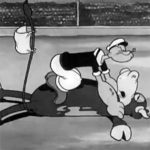 I Eats My Spinach (Fleischer/Paramount, Popeye, 11/17/33 – Dave Feischer, dir., Seymour Kneitel/Roland Crandall, anim.) – One of the earliest Popeye cartoons finds the sailor and Olive attending a rodeo (on one ticket, passed to Popeye by Olive’s big toe over the fence once Olive is already inside). Bluto is of course the main attraction, demonstrating fancy riding and roping, upon a steed that at a crack of a whip can magically divide into three smaller horses, then reassemble again. When Bluto flirts with Olive, Popeye is of course compelled to prove he is the better man, with his own fancy riding and bulldogging exhibitions. A champion bull is released, and Bluto finds him to be more than he can handle. Popeye, however, resorts to toreador techniques, making passes with the bull in classic cape-waving manner. Bluto, unable to top Popeye at the event, turns his attentions to roping Olive from the stands. An interesting four-way chase shot develops, with Olive pursued by Bluto pursued by Popeye pursued by the bull, and everybody playing a game of socking the one behind them (except the bull, who gets knocked down, and holds his aching jaw while saying “Oooh!”) Popeye finally eats his spinach, and knocks Bluto out of contention, but faces the mad charge of the angry bull (using a gag that would be reused over and over in Paramount cartoons, with steam shooting out of the bull’s horns like the whistles of a locomotive). With one mighty sock, Popeye launches the bull skyward, out of frame. When the bull returns to earth, he is already broken up into a wide assortment of fancy cuts, and from nowhere has appeared a butcher’s table, meat cleaver, apron, and chef’s hat for Popeye, topped with an awning over all reading “Meat Market”. This appears to be the original appearance of each of these last two gags. The steam whistle gag would be revisited not only in some of the Paramount cartoons discussed last week, but also in the opening scenes of “The Old Shell Game”. The meat market gag would cross-over into other studios on many occasions, including Woody Woodpecker’s “The Hollywood Matador” and Daffy Duck’s “Mexican Joyride”. It would even appear in a non-bovine setting (the victim being a wild boar) in Mighty Mouse’s “Aladdin’s Lamp”. Paramount itself would reuse the gag in the Technicolor semi-remake of this film, “Rodeo Romeo” (although the remake does not include cape fighting), and also in “Thrill of Fair”. Notably, a home movie edition consisting of a digest of the last half of the Fleischer original chose a retitling spotlighting the closing gang, renaming the film, “The Butcher”.
Carmen (Lotte Reiniger, 8/34) is a German silhouette-animation short about the characters from Bizet’s famous opera, but definitely taking some liberties with its plot, even adding a happy ending (not what Bugs Bunny would expect in an opera). A film definitely aimed at the adults rather than the kids, it seems that IMDB’s summary of the storyline says it all, and is reprinted here:
“Carmen seduces a soldier. She takes him home to the Gypsy camp, and while he sleeps, she steals his clothes and weapons. She trades them for an elegant dress, but even with fine clothes, she can’t get the time of day from the toreador. She goes to the bullfight, where the soldier tries to come after her with a dagger. She gets into the ring and manages to seduce the bull, who takes a rose from her mouth. She rides off on the bull with her man.”
A bull taking a rose from Carmen’s mouth? Did Munro Leaf hear of this when writing “Ferdinand”?
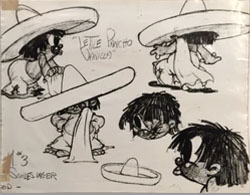
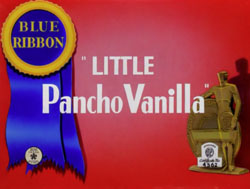 Although glancing mention of the film was finally brought up in one of the last comments to last week’s bullfighting articles, I feel compelled to give coverage to Little Pancho Vanilla (Warner, Merrie Melodies, 10/8/38 – Frank Tashlin, dir.). This remains, for reasons of stereotypical portrayals of Mexican characters, one of the hardest to see Merrie Melodies, rarely if ever getting airplay. (None of the local stations in any of the Boston or Los Angeles markets who had access to the A.A.P. package were ever known to show it in my day.) This for many years provided an intriguing mystery for comic-book collectors, who would frequently encounter Little Pancho Vanilla stories among Warner Brothers’ comic reprints, yet had no idea of his animation connection or whether his depiction in film was anywhere close to the printed characters. The short answer to the question is, no – there was little resemblance between the film and the strip. The comics depicted Pancho as an average Mexican child, of reasonable intelligence and skill, dreaming of growing up to become a bullfighter, but dealing with the nervous antics of his frustrated father, who has been around the block enough to see through all the glamour of being a Torero, and is more aware in his present state of the dangers of the occupation, and of the on-the-job frustrations of pleasing his boss Ranchero. The comic series was well-drawn, without any strong suggestion of stereotype with the possible exception of Mamacita, and generally reasonably entertaining. The same cannot be said of the Tashlin original. It is first hard to determine how the comics artists arrived at their own designs and models for Pancho, as Tashlin’s child looks nothing like him. Tashlin continues to use the broad round face structure and apple-cheeks we associate with his unique designs for Porky Pig, on Pancho and Mamacita. And there is no sign of Papa in the film, nor of any Ranchero. The plot line is absolutely meager.
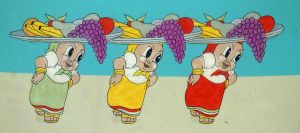
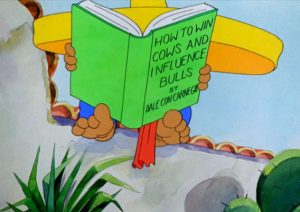
 Pancho wants to win a bullfight’s prize to get his Mamacita a washing machine, to save her from hand-scrubbing clothes at water’s edge. He studies the art of bullfighting from a book entitled “How to Win Cows and Influence Bulls” by Dale ConCarnegie. A good 4 minutes of the cartoon have passed before we even enter the arena, wasted mostly on three young girls performing a musical number and periodically teasing Pancho. They eye a poster advertising matador Don Jose at the bullfights – a dead-ringer for Clark Gable. Egotistical Pancho (who was never egotistical in the comics) insists he’s better, and when laughed at, sets out for the bull ring to prove himself. It is amateur day at the arena for unskilled matadors, picadors, swinging doors and cuspidors – but even in this setting, Pancho is not welcome at the door, and is referred to as a “little shrimp”, not a matador. As other contenders enter the arena, the bull is seen off to one side, readying his horns by chalking them up in the manner of a pool cue (a gag often repeated in other films). Calling his impending shot, the bull tells the audience he will sink the 8-ball in the side pocket. He charges the entire squad of would-be matadors, who just happen to be clustered in a triangle like pool balls. The matadors go rolling in all directions around the ring, all but one disappearing behind the upright barriers encircling the perimeter of the arena. The last one hits the arena fence, rolls upwards into the air upon its sides, and flies out of the stadium. Pancho is seated upon the top of a hay wagon, as the ejected matador lands upon the wagon’s tongue.
 Pancho is catapulted over the stadium wall into the arena, and lands squarely upon the bull, temporarily knocking him dizzy from the impact and bouncing off, to the tune of “shave and a haircut”. Sombreros fly into the air from the crowd, and pause in mid-air to spell out the words “Viva Pancho”. (Odd how they know his name, seeing as no one gave him an introduction.) Reaction is paced like molasses as Pancho takes in the plaudits of the people, and poses atop the bull for the newsreels, again devouring screen time with padding. The three girls, now in the stands, toss roses to him. Pancho bends over to pick them up, just as the bull revives, seeing Pancho’s protruding rear-end. When some action finally occurs on the screen, it is for reasons unknown paced way too fast, seemingly throwing away its material before the audience even has time to react, and making the meager comedy seem over before it starts. Pancho darts out of the bull’s way in the nick of time, the bull smacking head-first into the arena wall. The bull tries to stare at Pancho, but sees multiple overlapping and spiraling images of Pancho waving his cape. The bull regains his senses, backs up to the far end of the arena, and charges, launching Pancho over a football goalpost that has appeared from nowhere at one end of the arena. Pancho retaliates, charging the bull with his own head, and knocking the bull upwards into a basketball hoop that has equally-magically appeared on the other side of the arena. Now, the bull brings a third sport into play, pulling on his horn like an automobile stick shift, shifting into high gear like a racing car, and zooming in a circle along the walls of the arena to come up behind Pancho, knocking him upwards into the air. Saving on the budget in an already tedious film, the exact same series of shots as seen before is repeated, as Pancho again comes down on the bull’s head with a “shave-and-a-haircut” bounce. This time, the bull stays down, and the fight is suddenly over. A few more slow and poorly-timed shots close out the film, as Pancho wins the washing machine, which takes Mamacita’s place at the river’s edge.
 My guess is that this was the film that Eddie Selzer remembered seeing when he made the infamous remark that bullfighting cartons weren’t funny. In this instance, Eddie was 100% right. Though at least Jones would have been present in the studio staff when this cartoon was first released, he probably didn’t work on it, as I do not know of Jones ever being a part of Tashlin’s unit – so did he get or remember Eddie’s point of reference? It might have been hard to be unaware of the film’s existence, even as unmemorable as it is, given the film’s ongoing comic book connection, and the fact it was approved for a Blue Ribbon reissue at a point in time probably not too distant from the conference with Selzer. Even so, why was such a poor film ever green-lighted for a comic in the first place? Perhaps Warner was desperate for something to foster the “good-neighbor policy” with our southern neighbors, so the comic was a product with such wartime influences in mind? More curiously, WHY did the film receive a theatrical reissue? The reissue does not appear to be early enough to have occurred in wartime, so the good-neighbor policy isn’t the explanation. If Eddie Selzer hated it, then why reissue it? The uncharacteristic lack of quality of this Tashlin production should justifiably have spelled its death-knell in 1938, and its surprise longevity remains baffling.
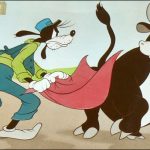
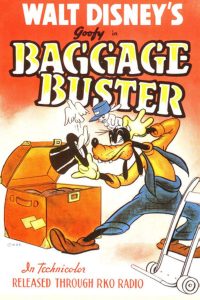 Baggage Buster (Disney/RKO, Goofy, 4/18/41 – Jack Kinney, dir.) – Goofy is station-master and baggage handler at a rural railroad station. He receives a telegraph message that a magician’s trunk must be loaded on the next departing train. Before the train arrives, Goofy attempts to place the heavy black trunk in position upon the platform for pick-up. Easier said than done. The trunk itself is full of tricks, including a detaching carrying handle, self-levitation, and a built in saw-the-lady in half trick. Worse yet are the trunk’s contents, which include a magic hat and cape concealing a veritable menagerie of live animals. The hat produces birds and bunnies, a half-dozen or more at a time. When Goofy removes the cape from the trunk and allows it to fall upon the platform, it begins to rise of its own power, revealing under its fabric the hooves and torso of a massive bull. The bull’s design and initial mannerisms lead one to believe he is some kind of a twin cousin to Ferdinand, as he lays a slurping kiss upon Goofy’s face when Goofy peers under one edge of the cape. But Goofy will have no part in this nonsense, and takes hold of the cape, waving it at the bull to shoo him away. Wouldn’t you know it, Goofy chooses to present the cape with the inner lining-side out, displaying a waving pennant of red. The view of this sight changes the disposition of the bull from lovable and harmless to fierce and peeved. He begins to paw the wood of the platform, readying himself for a charge. Goofy becomes aware of his error in color choice, and begins to meekly wiggle the cape in an embarrassed, apologetic manner, as if to say, “I really didn’t mean to. It was all in fun.” Too late to change the bull’s mind. He charges Goofy at full speed, and the Goof ducks his head behind the extended cape, not having the sense to attempt a bullfighter’s pass, but helplessly believing the cape will provide some sort of barrier to the imminent impact. Oddly, his dim-wit instinct to merely duck turns out to be the proper move, as a collision with the bull’s horns never occurs. Instead, the bull is magically swallowed up into the fabric of the cape, disappearing back to from whence he came.
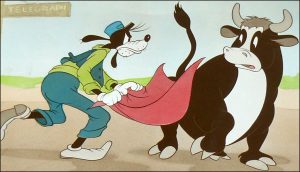 Goofy continues to be confused, shaking the cape out in attempt to determine where the bull went. Instead of the bull again, Goofy produces from the cape a boxing kangaroo! Things continue to escalate and get out of hand, until Goofy tries to dispose of the cape altogether by tossing it away. Just his luck, his random throw lands the cape caught between the blades of a rotating electric fan at his station house, and the whirling cape dispenses an entire zoo of animals (some even appearing to be weird mutants of more than one species at once). Goofy spends at least the last minute or more of the film rounding up the stampede before the train arrives, stuffing and compressing all the animals (even an elephant) back into the trunk and locking it tight. With his baggage cart, he wheels the trunk up to the open door of one of the train’s box cars, and gives it a mighty shove, rolling it end-over-end through the doorway. He fails to notice that the door on the other side of the car is also open, and the trunk merely rolls through the second doorway and off the train again, its lid springing open. When the train pulls away, Goofy stares in shock, at another menagerie even larger than the first, staring at him from across the tracks. Goofy ends the film by running down the tracks after the fast-departing train shouting a line which fades in volume by the last line. I believe the stated line is “Hey, come back! You forgot sump’tin’!” It might have been funnier if he had said “Hey, come back! You forgot ME!”
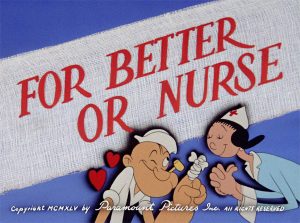 Bullfighting would again be included in a Popeye cartoon in For Better or Nurse (Paramount, 6/8/45 – I. Sparber, dir.), but this time, not by Popeye. This Technicolor reworking of Fleischer’s “Hospitaliky” has Popeye and Bluto rivaling each other to get themselves laid-up in some form of terrific accident, so that they can be admitted to the hospital at which Olive works as a nurse. Bluto tries a new method in the remake, by stepping out into an open pasture resided in by a hot-tempered bull, and waving a red cape at him, then tucking one end of the cape into his shirt collar, so that the bull will charge directly at him. We again get the steam-whistle horns gag from “I Eats My Spinach” as the bull charges. But just before the point of scoring a gore on Bluto, the bull slams on the brakes and skids with his hoofs to a total stop, his eyes diverted to an image on a billboard sign standing prominently behind Bluto. The sign is for a dairy company, depicting their feminine mascot, Fifi the Cow (a play on Borden’s famous trademark character, Elsie the Cow). The bull’s disposition changes instantly to love, his horns soften and droop to the sides of his head in non-threatening manner, and he plants a big, juicy kiss on Bluto’s face.
By the way, this remake has a better ending than the original, as Popeye winds up being the one who gets injured, but the hospital in which Olive works turns out to be a cat and dog hospital. The two distraught sailors go looney, reacting by letting out with endless meows and barks, and are both finally carted off to a medical institution – in a paddy wagon, bound for the Happy Valley Screwball Institute.
• FOR BETTER OR NUSE is on DailyMotion.
 Though it doesn’t play by traditional arena rules, it’s hard to ignore Mexican Baseball (Terrytoons/Fox, Gandy Goose, 3/14/47 – Mannie Davis, dir.), a creative idea where the real-life popularity of the Mexican baseball leagues and cross-over of personnel between such leagues and the U.S. majors is exploited by the Terry writers, through the creation of a new brand of the sport that is as much bullfighting as it is baseball. The two major leaguers lured to play in Mexico are Gandy and Sourpuss, who arrive in an old jalopy at the entrance to a bull ring converted into a baseball stadium. They present themselves as a two-man visiting team, while a Mexican band plays a slightly off-key rendition of “Yankee Doodle”. Then the home team is introduced, as gates across the arena open – releasing a stampede of charging bulls, dressed in baseball uniforms. Gandy and Sourpuss are driven waist-deep into the ground as the bulls charge over them, then watch as the bulls mix it up with tosses of baseballs along the baselines and outfield. Gandy remarks to Sourpuss, “On second thought, I think I’ll go home.” Sourpuss (played in this one cartoon by Paramount regular Sid Raymond), angrily responds. “Listen. You’re in this as deep as I am. I’m gonna see this through, even if it costs me YOUR life!”
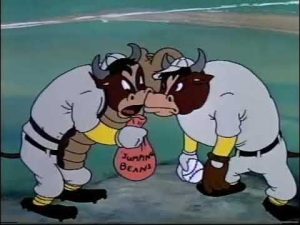 Gandy struts to the plate, but rolls himself there the second half of the way, slipping upon a continuous row of bats placed on the ground up to home plate. A bull catcher picks Gandy up, and uses him for a whisk broom to dust off the plate. The pitcher’s first pitch is so powerful as to knock even a bull catcher to the backstop. Gandy gets a bat upon the second pitch, and races around first. But the ball is tossed to the second baseman, and the old pickle-play is on. Gandy reverses directions so many times in running between first and second, his feet dig a trench into the ground, and Gandy disappears within. As the second baseman looks down into the trench for him, Gandy pops out of the ground behind him, and kicks the baseman into the hole. Gandy heads for second, and the first baseman tosses the ball after him. Gandy rounds the bags, with the ball in close pursuit, changing directions at each corner to match his step. Sid Raymond performs his track-announcer voice from a racetrack, calling the race between player and ball as coming into the home stretch neck and neck. Gandy slides while the catcher waits to receive the ball at home. Gandy’s slide takes him between the waiting bull’s legs, and he seizes the plate, ripping it from the ground and taking it with him nearly to the backstop, beating the tag. First run for the Americanos, with the band playing another refrain of “Yankee Doodle”.
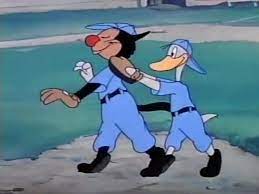 Now, Sourpuss’s turn. The pitcher tries one which should probably have been called a ball anyway – leaping high into the air off the mound, and launching a high-altitude slow ball. But Sourpuss turns it into a hit, acquiring a step-ladder to stand upon as he swings. The ball is hit straight up, and makes a pass over the crescent moon (lifting a gag from the studio’s own “Barnyard Baseball”). In close parallel to Goofy’s “How to Play Baseball”, four bulls converge in the infield with shouts of “I got it”, slamming into one another and knocking each other cold, while the ball lands untouched between their four sets of feet. Sourpuss dances unopposed around the bases to the crowd’s cheers, but has some of the grandeur of his scoring at home taken away as he trips over a water bucket after crossing the plate, depositing the pail atop Gandy’s head.
Gandy returns for another at bat. The bulls prepare a sabotage, loading the ball with Mexican jumping beans. The pitch jerks up and down, back and forth in all directions as it approaches the plate. But Gandy is sharp-eyed, and keeps up with it, giving the ball a clout. The strategy backfires on the bulls, as their fielders can’t seem to lay a glove upon the perpetually bouncing ball, and Gandy scores again.
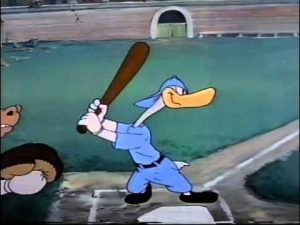 A montage of shots shows Gandy and Sourpuss continuing to score, inning after inning, until the bottom of the ninth, with the bulls behind 21 to zero. Sourpuss pitches, while Gandy acts as catcher. Though the bull at bat carries six bats, Sourpuss’s spinner makes short work of them, sawing all of them in half. Gandy imitates the catcher in Tex Avery’s “Batty Baseball”, darting out in front of the bull repeatedly to catch the ball. The bull picks Gandy up by the hat, deposits him back behind him, then hammers with his bat upon Gandy’s head, to drive and root Gandy’s feet firmly in the ground. Sourpuss’s fireball does the usual of burning the bull’s new bat into a matchstick. In a clever new original gag, Sourpuss’s third pitch stops in mid-air just before the mound, and a small mechanical hand pops out of the ball, waving a red cape in front of the bull’s eyes (thus, fully making this film eligible for discussion here). The angered bull still manages to hit it, and charges around the bases on all fours. But Gandy, still remembering that loose concrete slab at home plate, pulls a fast one – driving his shoe spikes into the plate, then hopping into the air as the bull approaches, taking the plate with him. Gandy and the plate land on the sliding bull’s back, and Gandy tags the bull out with the ball. The band again starts playing “Yankee Doodle”, but the bulls’ team captain appears at the bandstand, yelling “Silencio”. The bandleader pauses, and listens as the bull whispers a suggestion into his ear. “Ah, si si!”, responds the bandleader, and with a tap of his baton, signals the band for a change of mood. They break into a spirited conga rhythm. The bulls are into this kind of music, and begin dancing around as they approach the plate. Even Gandy finds himself taken by the rhythm, and starts to do a few steps himself behind the plate. With swiveling hips, the bull batter delivers a mighty blow to Sourpuss‘s first pitch, and congas his way toward first. Without even waiting for the batter to reach base, another bull comes up to bat, repeating the hit of the first. One bull after another repeats the action, each of them linking an arm to the shoulder of the runner ahead of them as they proceed down the line. Soon, the entire diamond is lined with conga-dancing bulls, making hit after hit. A close shot shows us Gandy and Sourpuss on the mound, now completely caught up in the spirit, and conga-dancing together. “Who’s winning?”. asks Gandy. “Who cares?”, replies Sourpuss, “We’re having fun.” The dance continues endlessly to the crowd’s cheers, as we fade out.
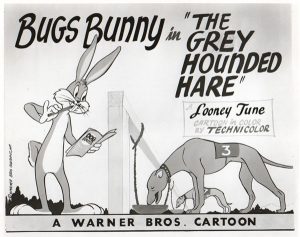 We end this week’s installment with a Robert McKimson classic which unexpectedly falls into this subject category for one of its closing gags. I am glad of it, as it finally gives me a chance to discuss The Grey-Hounded Hare (Warner, Bugs Bunny, 8/6/49), a cartoon which otherwise generally defies categorization along any animation trail. For many years, before my exposure to Columbia cartoons and the full library of Terrytoons shorts, I had thought this film to be the only cartoon ever made on the subject of dog racing – a sport which in my childhood was still popular along the Eastern seaboard. I later learned it was not quite alone, having been pre-dated by Columbia’s Color Rhapsody, “The Greyhound and the Rabbit” (1940), and followed by a short sequence in Terry’s tortoise-and-hare spoof, “A Hare-Breadth Finish” (1957), both also excellent favorites. Though not forgetting a left turn at Albuquerque, Bugs somehow winds up coming out of the ground at a dog racing track. Spotting a discarded program of the contenders in today’s races, Bugs decides to wander into the kennel and give the racers a once-over, presumably before placing a bet. During his inspection, he irritates the favorite of the feature race, who by nature is a rabbit hater – even insisting the dog open his mouth so that Bugs can inspect his teeth. Of course, Bugs finds fault with same, telling the dog he has a shadow around his bicuspidor, and should see his dentist. The dog attempts to lunge at Bugs, but is tethered by a collar and chain fastened around his neck, so can make no forward ground. Instead, his wild clawing of front paws digs himself a hole halfway to China.
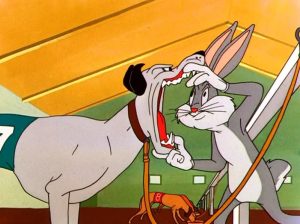
“A little shadow on that bicuspid… better see your dentist!”
,p>
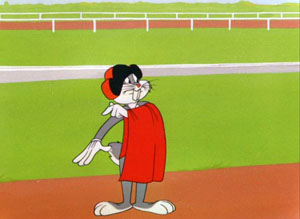 As for what is left of the racers, Bugs gets ahead of them, and jeers a “Nyah Nyah” at them, luring them to chase him off the track through a grandstand exit. Just outside the gates, Bugs spots a taxi waiting for its next rider. Bugs leaps into the cab’s open passenger door, and is immediately followed by the dogs. But Bugs double-crosses them by exiting out the opposite cab door, slamming it shut in the face of his pursuers. As the cab fills to capacity with canines, Bugs shouts directions to the driver: “The Dog Pound. Hurry!” The cab zooms away, removing the mutts from the picture – all except one. The favorite, the one Bugs irritated most, never got on board, and is still determined to sink his teeth into some potential hasenpfeffer. Bugs thus wages a one-on-one war with the remaining dog back on the track, raising the railing to trip him when he re-enters the race track, sending him chasing after a fake balloon rabbit into the sky, and finally getting him to fetch a stick – of lit TNT. All the while, Bugs tries to flirt with the mechanical female each time she whizzes by, pitching his best come-on lines at a pace equal to her speed: “HeyDreamboathow’saboutyouandmemakingbeautifulmusictogether?”
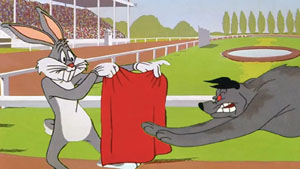 The dog, charred almost black by the last explosion, rises from a crater in the ground, extends his ears forward past his forehead like a pair of horns, snorts, and paws the ground, exactly in the manner of a bullfight charge. McKimson, who sometimes had a habit of over-explaining a gag, has Bugs verbally assess the visual setup, with the unnecessary remark, “He’s charging like a bull.” In a gag that would be remembered by Chuck Jones and Michael Maltese as one of the first tricks Bugs uses in the ring in the later “Bully For Bugs”, Bugs holds a cape out before the charging dog, his hands shaking as if afraid he is not ready to face such a challenge. But instead of a pass through the cape, the dog clangs hard into something metallic, concealed behind the cape. Bugs pulls the cape away, to reveal a fire hydrant. (In “Bully For Bugs”, it was an anvil.) The dog remains unconscious – but a white flag of surrender rises upon his tail, as if hoisted by someone up a flagpole. Nothing left to do but strike up an acquaintance with the girl of Bugs’s dreams. As the robot approaches along the fence again, Bugs leaps onto the rail, catches the robot’s front paws with both hands to slow its progress, and bends to give it a kiss. “ZZZZZAAPPPPPPP!!”, as massive volts of electricity turn Bugs momentarily into a Technicolor lightning bolt. The robot disappears back into its starting box on the rail. But Bugs is none the wiser, and totally impressed at the impact of the girl’s lip-lock. “Baby!! This looks like the beginning of a bee-yoo-tiful friendship!” So, our gullible, love-struck hero hops onto the railing again, and extends his lips into the holding box for another smooch – and another massive zap of current – for the iris out.
• “The Grey-Hounded Hare” is on Dailymotion
NEXT WEEK: More theatricals, and likely some television, as we continue this special supplement.