
 Slightly shorter coverage today, as there’s been some personal disruptions in the research schedule of late (which might result in the last chapters of this series being released more sporadically), and as we are reaching a stage of Lantz’s production where song material became somewhat less prominent in favor of original scores and gag-laden films trying to keeping pace with competitors such as Warner and MGM.
However, Lantz continued to spotlight music in his new third series of releases of musical one-shots, to be given the name “Swing Symphonies”. It is from these that all material for this instalment derives. We’ll take things through the initial period where scores and orchestrations were strictly provided by Darryl Calker and his chosen sidemen, through the first of said films to feature the prominent work of a guest artist.
Boogie Woogie Bugle Boy of Company B (9/1/41) – Harry Hurricane is the hottest trumpeter going – until conscription came along, and he was literally “Gone with the Draft”. The captain of this all-colored company is determined that our boy play a bugle, to blow reveille at exactly 5:00 in the morning. Harry gets a choice that sounds quite unappealing: “Do we get Reveille, or do you get Taps?” The rest of the cartoon pretty much follows the script given by the lyrics of the song. Eventually, the company does jump when he blows Reveille on his actual trumpet as opposed to a mere bugle. Song: the title number, a 1941 boogie composition, popularized by the Andrews Sisters, who recorded it for Decca. Their version was also issued on a special Universal Pictures disc in promotion of the picture “Buck Privates”, and on V-Disc. Mitchell Ayers and His Fashions In Music issued the Bluebird cover. Gene Krupa would cover the number for Okeh. It was revived in 1973 by Bette Midler for Atlantic.
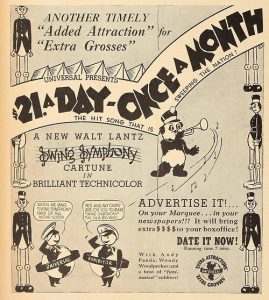 $21 a Day (Once a Month) (12/1/41) – The first official “Swing Symphony” in its billing. Basically follows the daily routine of an army regiment of toys in a toy shop, set to the novelty title tune in various tempos (including a portion of the arrangement played close to Spike Jones style). Features a number of cameos from Lantz’s stable of characters, nominally appearing as toys. Andy Panda blows bugle call for pay day. Woody Woodpecker is last in a line of drilling soldiers, marching completely out of step in his own unique hop – and soon gets the whole line of toy soldiers doing it. And there is even a cameo for the solo tent of Private Snuffy Skunk. $21 was the pay scale of an army private at the time, and many novelty songs were written at the time about the sudden transition from civilian to army life. In the cartoon, there is even a “Club Boogie”, where toys probably go to blow their monthly pay. The Song: was recorded by Dick Robertson on Decca, probably for the juke box trade, with the most verses appearing on any version. Tony Pastor had an unexceptional version for Bluebird, including only one vocal verse. Dick Rogers issued a version on Okeh possibly fronting the personnel of the Will Osborne band when Will took a break from the business. Phil Arnold with the Lud Gluskin Orchestra performed a comic Soundie, with Arnold doing K.P. and fantasizing about how he would run things if in charge, leading to a dream of an all-girl kitchen.
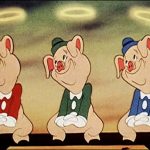
The Hams That Couldn’t Be Cured (3/4/42) – Mr. Algenon Wolf, local music teacher, is about to be hanged at dawn for attempted murder upon innocent three little pigs – until he is allowed to tell his side of the story. Transforming his voice from tough yegg to effeminate tones, he recounts the morning the pigs arrived at his comfortable home, seeking someone to “loin” them music. “Shoot the tune to me, goon”, one of the pigs says. It is obvious the pigs know some music, and they convert a beginners’ piece, “Kreutzer’s Etude” (a classic exercise for violin, most often associated with the music lessons taken by Jack Benny with Professor (Mel) LeBlanc) into a dixieland jamboree. The pigs huff and puff on their instruments, turning the wolf house into a shambles, and inflating its walls so that it blows apart from the inside. The sheriff is swayed, and orders the crowd to “Get those three pigs”. As the mob leaves in pursuit of the trio, the wolf reveals to the viewing audience that it was all a big lie he put over on them – but he accidentally pushes the lever to the trap door of the gallows on which he is standing – and miraculously ends up suspended by his tail from the noose, screaming to be let out of here. I am not able to locate any commercial recordings where the Etude was actually performed straight for the commercial market.
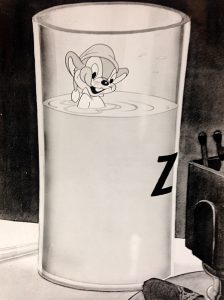 Juke Box Jamboree (7/27/42) – At the Zowie Café, a night spot named after its signature (presumably alcoholic) drink concoction and specializing in South American rhythms, a small mouse can’t get any sleep, thanks to the endless Latin music pouring out of the jukebox. The jukebox operates on the same costly principle as one later seen in Woody Woodpecker’s Real Gone Woody, disposing of played records by hitting them with a hammer, then sweeping the crumbs off the turntable with a whisk broom. The mouse comes out of his mouse hole, enters the jukebox (whose tone arm somehow interchangeably can play discs from both the left and right sides of the center spindle), but can’t get the tone arm off the record, instead himself spinning round and round on the disc. He is thrown out of the machine via the coin slot, and lands in a full glass of Zowie. One taste, and he is hooked, lapping up the glass’s contents down to the last drop – and instantly feeling intoxicated. The remainder of the film is seen as his dream, with ghostly spirits appearing out of bottles matching their dimensions, and forming a Latin band to entertain. Turtles in a pond commence to dancing, while images of senoritas on a lampshade come to life to dance around it – becoming all the more revealing when the mouse turns on the light to reveal the silhouette of their shapes within their wide dancing skirts. The mouse incurs an impact that seems to break him up into dozens of transparent duplicates of himself, who all proceed with him in a conga line back into the mouse hole, where they one-by-one settle back into his mousetrap bed along with him for a good night’s sleep. Songs: A variety of presumably original Latin-themed pieces, mostly instrumental, but one sung in a best attempt at Portuguese by a Carmen Miranda lobster and back-up trio of matchsticks. Nominated for an Academy Award.
• “Juke Box Jamboree” is at https://vk.com/
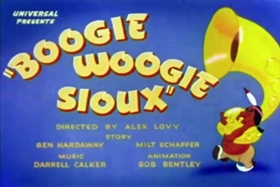 Boogie Woogie Sioux (11/30/42) – More or less Lantz’s reworking of Warner Brothers’ “Sioux Me”, with an Indian reservation at Beetle Brow, Arizona (where the sand meets its dune) facing the usual problem of crops burning up for lack of rain. Cactus transforms into a shrunken whistling tea kettle. Pumpkins bake into instant pumpkin pie. Chief Red Corpuscle calls on rainmaker Silex Drip for a quick fix. Drip’s old-fashioned tom-tom beating does nothing but elicit laughs from Old Sol, who turns on the heat to crack the landscape as if opening an earthquake trench, almost chasing the chief off his lands until he throws a railroad switch and sidetracks the traveling crack off onto a side spur line. Drip is literally given the boot – right into a dry well. Along comes the band truck of one Tommy Hawk and his 5 Scalpers. Is he a rainmaker, he boasts, setting to work on his own modern drum set, complete with cymbals. His band rhythm soon has the distant clouds dancing away from the tops of far-away mesas and covering the landscape with life-giving rain, reverting the crops back to normal. Tommy and his band continue to play, covering the landscape in about four feet of moisture while they play on water-soaked instruments atop pueblo roofs. As the iris attempts to close upon the picture, the waters pour through the hole out into the audience, as the words “The End” appear above the hole. Song: Difficult from the lyric to tell if it had a more formal title, but we’ll call Tommy’s original raindance rhythm, “I’m Tommy Hawk”.
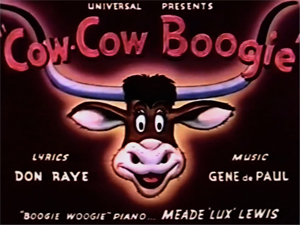 Cow Cow Boogie (1/3/43) – A ranch foreman is fed up with the shiftless cowpokes who are supposed to attend to the ranch’s herd of cattle, but instead spend nearly all of their time lounging on the front porch of the ranch house and singing endless choruses of “Home on the Range”. (One cowboy can’t resist putting over the obvious joke of singing while seated atop an old oven – a range, of course.) The foreman gets their attention by shooting his pistols in the air, causing them to hide behind the porch’s upright posts. “That’s all I ever hear. You boys spend more time at home than you do on the range.” The foreman blames the song for slowing down production, and vows that he must get the boys a new tune. Enter a passing Negro traveler riding (or rather, straddling while walking) a donkey, singing a song about himself as a “swing half-breed”. The ears of the foreman perk up, and with one deft lariat swing, the traveler is yanked from his steed (and out of most of his clothes). He protests, asking the foreman what he wants with him. The foreman responds that all he wants is more of that boogie music. “Well, all right!” replies the traveler, and proceeds to a piano, where he belts out some boogie, with the same results as always in a Swing Symphony – everybody on the ranch perks up, and the cattle-drive progresses at full swing. Most gags are rather routine, but one clever one has the foreman branding cattle as Grade A Beef, until a cross-eyed, dippy, giggling cow steps up in line – to be branded as Jerky Beef. The entire herd finally departs aboard a cattle train, with the traveler continuing to play piano atop one of the cars. As the train pulls out, we see its name on the caboose – the “Super Beef”.
This would mark the first Swing Symphony to feature billed star power for its musical performance, crediting the boogie woogie piano work to Meade “Lux” Lewis. Lewis was a prolific boogie woogie artist and composer, author of “Honky Tonk Train Blues”, and recorded extensively for Blue Note ad other labels. He is also remembered for duet and trio work with Pete Johnson and Albert Ammons. In this film, he does not sing the title song, nor does he appear to perform it instrumentally, his section of the cartoon consisting of an untitled boogie instrumental, likely a piece of his own composing. It is unknown if the work ever acquired a formal name or was included anywhere among his many commercial recordings.
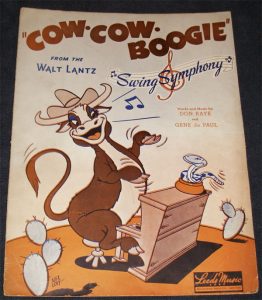 As for the title song, it has a curious history. It was composed for and originally intended to be introduced in the Abbott and Costello feature, Ride ‘Em, Cowboy. Ella Fitzgerald and the Merry Macs were signed for the picture, marking Ella’s screen debut. The song was recorded (a rare Universal studio disc exists in the hands of collectors, containing the soundtrack version on side 1, and Ella’s second number from the film, “Rockin’ and Reelin’”, as the flip), but at the last minute was cut from the film, the producers deciding to make a substitution to capitalize upon Ella’s successful recording career. To give her instant recognition on screen, her opening number became a version of her famous recording hit, “A Tisket A Tasket”, which she had performed with the Chick Webb band on record, instead of presenting her singing an untested new number. The producers should have left well enough alone, as their new number proved to be just about as powerful a record seller as Ella’s old hit. Ella did ultimately issue a recording of the piece on Decca, accompanied by the Ink Spots, which scored respectable sales. But, without the connection of the number to her from a film performance, the hit status went to newly-formed Capitol Records, who scheduled their first recording session with bandleader Freddie Slack and vocalist Ella Mae Morse to cover the piece. The recording was said to have been waxed in one take, and Ella Mae would relate that she broke into tears when session director Johnny Mercer would not let her have a second crack at the vocal. Johnny claimed that it was already perfect. His judgment must have been right. It sold a million copies. As for the sheet music, the Lantz cartoon, probably already in production concurrent with the filming of the feature, continued on track despite the cut of the number from Ella’s performance – so, by default, Lantz’s film became the song’s screen debut, and an illustration of the cattle from the film would appear on the published music’s cover. Other recorded versions included Yvonne Blanc and her Trio Swing on HMV’s “Disque Gramomophone” label, a London recording by Fats Waller as a piano solo, released posthumously and transcribed from piano roll, the Royal Air Force Dance Orchestra on British Decca, Joe Loss on HMV, an aircheck version (possibly by the Army Air Corps Band) of Glenn Miller issued on am RCA album, “The Lost Recordings”, a short version likely from an aircheck by Maxine Sullivan issued on an unknown album, and another aircheck from the Panther Room in Chicago by Gene Krupa’s orchestra with vocalist Anita O’Day. Joe Daniels and his Hot Shots in Drumnasticks would get the Parlophone version. Chico Cristobal and his Boogie Woogie Boys had a version on the Riviera label. Dorothy Dandridge would perform it in a Soundie. An anonymous solo, possibly intended for piano instruction, would appear on Statler Records. A 1954 country-rocker revival would be issued by Dottie Dillard on Dot. Another late revival was made by Chuck Miller on an unknown label. Even in the LP era, the song would be remembered by The Judds on the Curb album, “Heart Land”. But perhaps the wildest rendition would appear as the finale of the Jerry Fairbanks’ “Speaking of Animals” short, “Who’s Who (in Animal Land)” – sung by a live-action herd of cows with animated lips! The “Animals” short would win an Academy Award.
NEXT: Further into the 1940’s, including the first influences of James “Shamus” Culhane, and Woody acquiring a new singing voice.