
The creation of Hanna-Barbera is certainly the result of a perfect storm of talent, circumstances, and miracles. An extraordinary team of people, veterans and newcomers, gave even the most budget, time, and scrutiny-challenged entertainment a special spark. Most of the time, when they had the chance to make something good, it was better than good, it was great.
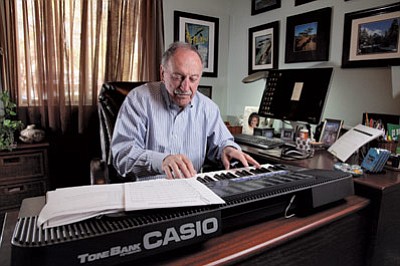
Ted Nichols at Hanna Barbera. Photo Credit – Ryan Williams:WGCN
One of those people is the often-overlooked composer/arranger/conductor Ted Nichols. Hoyt Curtin is considered TV animation’s musical genius, and rightly so. In 1963, when the studio started bursting at the seams from massive production demands and unparalleled success, Nichols began his H-B career. Along with Jack de Mello, whom we remembered in this Animation Spin, Nichols was among the additional music staff needed to get the scoring done at its highest level.
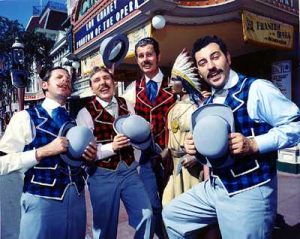
The Dapper Dans: John Borneman (tenor), Roger Axworthy (lead), T.J. Marker (bass), and Ted Nichols (baritone).
Walt Disney was among the guests enjoying the quartet during his countless park visits. Nichols told Marissa Freireich of the Williams-Grand Canyon Review in a rare interview. “The funny thing was, Uncle Walt as we called him, used to come there to Disneyland, and he’d sneak in and go over to the coffee place and sneak in the back,” Nichols told Freireich. “I’d just go over, sit with him, and have coffee.”
During his years as Minister of Music at Church of the Open Door in Glendora, California, he met an animator who was also a choir singer. “He liked what I did. And I kidded him one time, I said, ‘well why don’t you introduce me to your boss?’ The next week, I get a call from Bill Hanna,” Nichols said. Hanna, also a musician and lyricist, was an avid barbershop quartet singer (“Zuckerman’s Famous Pig” in Charlotte’s Web was a tribute to Hanna’s avocation).
Nichols’ earliest success for H-B was creating action/adventure cues for Jonny Quest. According to TV music historian Jon Burlingame, the composers did not collaborate. The orchestra sessions were separate. Nichols’ extensive experience as a musical director was evident, as was his ability to work within the general framework that Curtin created for Hanna-Barbera. This was a specialized technique requiring the ability to write cues for sequences in the works, as well as anticipating the need for additional cues that might necessary later in production.
Nichols proved astute in adapting his music to that of Curtin’s previous H-B cues. All of Hanna-Barbera’s TV cues were not the same. While the Loopy DeLoop and Yogi Bear Show cues had a similar tone, those for The Flintstones, The Jetsons, and Top Cat were distinct enough for sharp listeners to distinguish in most cases. These cues were heard in virtually all H-B cartoons of the early sixties. Nichols managed to blend his music with the other cues for Jonny Quest so it all functioned as a cohesive score.
 Hoyt Curtin, who worked often for Hanna-Barbera from Ruff and Reddy to Jonny Quest, went out on his own during sometime during Quest. As discussed on an earlier Animation Spin, he recorded a unique album of songs for a limited album released called Hollywood Directory. He continued to contribute theme songs here and there until 1972, when he returned to scoring cues.
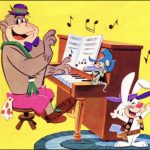
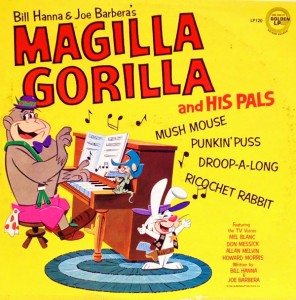
In the meantime, Ted Nichols was the H-B equivalent of Milt Franklyn at Warner Bros., composing music that continued the flippant, spot-on comedy of Carl Stalling. Nichols (along with de Mello) created cues for The Magilla Gorilla Show that became staples of H-B cartoons, as well as record albums, along with earlier Curtin music. In 1966, Curtin’s score for Alice in Wonderland, or What’s a Nice Kid Like You Doing in a Place Like This? and Nichols’ music for The Man Called Flintstone each yielded dozens of new cues, promptly added to the studio library (Alice cues can be heard as early as 1964.)
Ted Nichols’ music dominated such series as The Atom Ant Show, The Secret Squirrel Show, Space Ghost and Dino Boy, Frankenstein Jr. and The Impossibles, Herculoids, Shazzan, The Fantastic Four, Cattanooga Cats, Wacky Races and its spinoffs, Dastardly and Muttley in Their Flying Machines and The Perils of Penelope Pitstop.
Nichols occasionally post-scored Hanna-Barbera films and records. The assignment for The Man Called Flintstone was certainly a vote of confidence, as his experience, while considerable, was not as high profile in the industry as that of Marty Paich, a veteran of superstar recordings and television. Paich composed the background music for H-B’s first feature, Hey There It’s Yogi Bear (1964). However, his work for Alice and The Man Called Flintstone was limited to the songs, and those songs were not contracted for commercial records. Al Capps created simpler arrangements for Alice’s Hanna-Barbera record album based on the Paich charts.
For The Man Called Flintstone, Nichols was asked to do what Henry Mancini did for RCA Victor. Instead of using the soundtrack music, Nichols adapted his background scoring for individual album tracks. For the songs, Nichols created completely different arrangements for a small orchestra, although most of the vocal tracks came from the film. The album was released in mono, but the stereo version was also completed before HBR folded. The masters still exist.
When its own label ended, H-B partnered with Liberty Records to produce additional albums on their Sunset label (all remaining HBR’s were also re-labeled as Sunset). Two outstanding productions resulted, both featuring complete scores and songs created for the LPs. The albums were the authentic-to-the-series Shazzan and the Evil Jester of Masira and a spectacular musical extravaganza called The Flintstones Meet the Orchestra Family (click links for previous Animation Spins. The songs for both were written by John McCarthy, who also contributed songs to the Flintstone feature and the series’ first Christmas episode.
The New Adventures of Huckleberry Finn (NBC, 1968) was the first weekly series combining live-action and animation. It was one of the most expensive TV series up to its date (along with its competition on ABC, Land of the Giants). The higher budget allowed for more ambitious musical scoring. In addition to its memorable theme song and numerous cues, several episodes were post-scored. This was something Hanna-Barbera and Hoyt Curtin seldom, if ever, were able to do for television. For more about this extraordinary series, please enjoy this deep dive with author/historian Jim Fanning and me on The Funtastic World of Hanna and Barbera podcast (and please listen to other episodes, as well as the POP Culture Favorites Podcast).
Before he departed Hanna-Barbera for other musical endeavors, including an opera based on the John Bunyan novel, Pilgrim’s Progress, his grand finale with Hanna-Barbera were the iconic music cues for 1969’s Scooby-Doo, Where Are You? Before the groovy theme was added to the titles, one of Nichols’ most familiar Scooby cues was heard over the main titles. Like the cues from Huck Finn, the first season of Scooby was a treasure trove of background music, used in countless subsequent cartoons.
The premiere Scooby episode, “What a Night for a Knight,” was another of those rare post-scored films. It is fascinating to see the visuals match the action exactly.
We lost Ted this year, due to a long illness. Surely when St. Peter saw him at the gate, he said, “The composer for Scooby-Doo, Space Ghost, and Wacky Races? Come on in.”