
Writings from the Alumni and Graduate Students from the UCLA Animation Workshop.

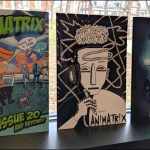
I hope the spring weather has begun to blossom in your neck of the woods as it has here in south-western Michigan! This month’s Card Catalog is the result of polishing up one of the criticisms from the first edition of the Animation History Bibliography, mainly that I had neglected to pull out individually authored chapters in edited compilations. And this has been an area that has proved to be a lot of fun to fix. Not only are there a lot of books with chapters written by many professionals across the world and notable animation historians, but there have been quite a few student journals with a focus on animation at Universities across the United States. The most successful of those journals comes from the Animation Workshop at UCLA called Animatrix. The journal was originally founded in 1984 and has published issues all the way up until 2016 where, apparently, it has been on hiatus since. The journals are published through the print on demand service, Lulu, where their three latest issues are still available to buy. I did, so today, let’s check out those issues:
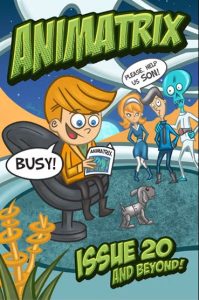 The earliest issue still available is Volume 20 published in June of 2013 and was coedited by Valerie Giuili and Kelly Lake. This issue’s theme takes an optimistic but tempered look at the future of animation and tries not to replicate the unadulterated optimism that we saw in the 1960s, the inspiration for their cover. The issue has three features. The first is a deep dive into the body of work of Lewis Klahr by Veronkia Ferdman. Ferdman zeroes in on the ways that Klahr uses stop motion and magazine clippings to have audiences contemplate some of Klahr’s larger contemplations on the passage of time and the presence of pain throughout our existence. In “Diving into the Uncanny Valley” by George Fleming, Fleming explores the history of the uncanny valley and argues how its presence in a multitude of 3D animated films throughout the last three decades are a result of attempting to reach various forms of idealized photorealism. Lastly, Alex Rosenberg looks at 13 Goofy shorts from 1940-2007 in “How To: Establishing a Star: The Goofy “How to” Shorts and the Evolution of a Character” and explores how Goofy became a stand-in for the present day everyman.
This issue shines, though, with three interviews; one with Peter de Seve by Alex Wong, another with Joe Murray by Kelly Lake, and the last with Craig Bartlett by Alex Rosenberg. In each interview each artist opens up, at length, about their own backgrounds, their methods and philosophies, and the way they see animation continue to change and evolve for the better and for the worse. Education, industry, and their personal histories are major topics throughout each interview and since this issue was published over a decade ago, it’s fascinating to see what has happened in the time since the interviews and today. As an example, Craig Bartlett explains his excitement to work on a potential new series at PBS called Dinosaur Train, and the strange ways and time it took to develop the pitch, which would not only be greenlit but would go on to have five seasons and a movie ending in 2021. Or how Murray discusses the potential and paradigm shift of the Internet’s effect on classical television distribution, even shouting out the work of then new Internet personalities like Egoraptor (Arin of GameGrumps), and the difficulties in launching a digital distribution network.
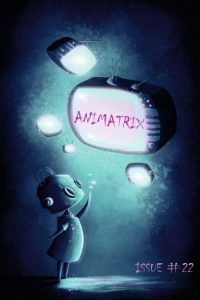 Volume 21 was released in March of 2016 and co-edited by Tenaya Anue and Graciela Sarabia. Innovation is the theme for the issue as without it we don’t have animation that continues to inspire or even to exist.
In “Mechanical Mod-sters: The Battle Between Realism and Surrealism at Fleischer Studios”, author Kynan Dias argues that the Fleischer Brothers’ relentless pursuit of mechanical innovation would result in their studio often creating stories that fit within the surrealist movement, ironic for the duo that invented the device that captures realistic movement in a very non-realistic medium. Building off of a quote of the Fleischer’s love of the surreal from Richard Fleischer’s Out of the Inkwell, Dias contrasts Robert Wiene’s The Cabinet of Dr. Caligari, the work of Luis Buñuel, and Salvador Dali’s Un Chien Andalou with Fleischer’s artistic output and finds quite a few similarities between not just the art but the artists.
Other articles include Kate Isenberg giving a quick biography of Bob Kurtz, highlighting notable milestones throughout his life and the ways in which his commercials pushed the medium forward. Rebecca Olson scrutinizes five pre-Snow White Silly Symphonies and the ways in which they experiment with realistic feminine movement that would eventually result in what is seen in the feature film. “From Monte Cristo to Gankutsuou: Externalizing Essence Through the Use of Animation”, Latoya Raveneau explains how the anime and the original Alexandre Dumas novel work in tandem to both elevate each artistic work as a collective whole. Lastly, Rasoul Azadani is interviewed by Rocco Pucillo and discuss, briefly, his background in animation, the meaning of and purpose of layout, and the power and success of 2D animation over the last century – success that gave Disney the power to be as big of a corporation as it was in 2013 (and is today, too).
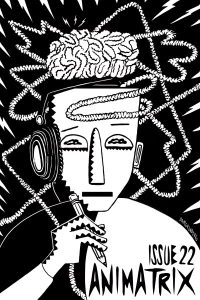 The last issue, hopefully just for the time being, came out in May 2016 and was edited by Zia Adsit-Metts. This time the theme is Animation for Television. Ben Greenwalk opens the issue with an exploration of the history and demise of the Saturday Morning Cartoon block, how captured young audiences and marketing opportunities that that provided while also exploring how that allowed for more creative endeavors throughout the decades. Greenwalk ends with a thought on the impact of today’s video game market and digital distribution as the final nails in the morning marathon coffin.
Four fantastic interviews are present in this issue, one by Sarah White interviewing Julia Vickerman, another by Kim Ngyuen with Richard Zimmerman, a third with Jasmin Lai by Julia Meng, and the last with Mia Resella with Van Partible. Vickerman’s interview is a great time capsule as at this point in time, Vickerman had been working on the Powerpuff Girls reboot and describes the process of pitching Twelve Forever which would eventually come out in 2019. Ngyuen’s interview with Zimmerman is super fun as it’s mostly an exploration of the way that Zimmerman animated various projects from the original Gumby series to the then new episodes of Robot Chicken. Jasmin Lai gives a background of their experience at the Rhode Island School of Design and the ways that helped get her career started. The interview ends with Lai lamenting that they’re not the greatest at background work – Lai’s most recent work was designing the backgrounds for Pixar’s Elemental. I think I enjoy every interview Partible gives. As he explains in the interview, he became a showrunner so early in life and at such a unique point in Hanna Barbera’s history that it’s hard not to find any of his answers interesting.
I really appreciate these volumes because their authors are full of excitement and hope for the future of animation and the ways it is changing. Today we know that the world these issues described is a bit more complicated with old methods changing, new technologies always redefining what has come before and what is coming next, and new institutions that are combining and redefining. But, like these journal issues point out, there are always new things born out of the old and independent and entrepreneurial enterprises are underway today that will continue to change the rules of the game in the future. Like Craig Bartlett said in his interview, the industry is constantly under revolutionary changes, distribution is a constantly changing game, but the role of the animator and storyteller stays the same.
As mentioned at the top, you can order each of these issues through Lulu, but the UCLA Animation Workshop website also has their interviews and the first ten issues available online and for free. And as always you can enjoy the complete Animation History Bibliography section of the Cartoon Research website. See you next month with another round up of animation book news and reviews!