
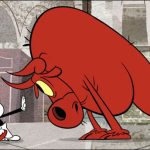

And so we come down to the Moment of Truth – a final look at the animated world of bullfighting. Disney, Warner, Film Roman, and Dreamworks all contribute short chapters from recent decades – plus, extended coverage of a notable feature film with a heavy emphasis on the bullfighting angle.
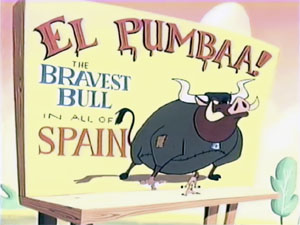 The Pain In Spain (Disney, Timon and Pumbaa, 11/3/95) – In their worldly travels that set the theme for their television series, our heroes wind up in España. A billboard in the countryside advertises an upcoming bullfight in the big city featuring El Toro – a bull so mean, the sign includes a scoreboard to keep track of the number of matadors he has gored. Timon gets into a bragging mode, boasting of what he could do if he were to face Toro himself. To demonstrate, Timon dives into their traveling suitcase and comes up dressed in a matador suit. He asks Pumbaa to use those useless tusks and charge at him. Pumbaa does one better, having just happened to pack in the suitcase for just such an occasion a bull costume to wear. Timon asks Pumbaa to go way back before starting his charge – so far back, that Pumbaa disappears beyond the horizon, and has to call Timon from a pay phone to ask if this is far enough. Pumbaa takes a few paces backwards to rev up his feet motors – and repeats the mistake of Ferdinand, backing into the sharp needles of a cactus. As with his Disney bull predecessor, Pumbaa charges with such force as to mow Timon down, and repeatedly trample him about six or seven times on repeated passes. (Timon sees miniature bull horns circling around his head, like so many tweeting bords.) Also as with Ferdinand, Pumbaa’s moves are observed by two bullfighting scouts, who capture and cart Pumbaa away as the new attraction for the bull ring – news that is not taken well by El Toro, who is given the heave-ho from his employment as nothing but a has-been, and swears revenge.
Timon learns where Pumbaa has been taken, by the heavens giving him “a sign” – in the form of a new billboard poster plastered right over him, announcing Pumbaa’s debut. “A brave bull?”, remarks Timon, making a bad joke despite his lack of an audience, that Pumbaa is really nothing but a “cow-ward”. Timon trails Pumbaa to the bull ring, and sneaks past the guards of the bull’s dressing room by being launched by the blades of a ceiling fan through an open transom window. Reunited with Pumbaa, Timon asks why he didn’t just take off the costume and explain he’s a warthog? Pumbaa cries, “The zipper’s stuck!” The only unguarded door of the room leads straight into the arena, posing a definite problem. A sign inside the door reads, “Wash hands before goring”, and a bowl of water and red cloth towels are provided in the room for such purpose. Timon picks up a towel, and states he’s got an idea. Pumbaa asks if his idea is to use the towel as a cape, perform an act for the crowd as bull and matador, then make their escape while the crowd is cheering. Timon sarcastically responds to Pumbaa’s stealing of his thunder, “No”, and that his idea was to locate a fairy to sprinkle pixie dust on the towel so that they could fly away upon it into the heavens. Pumbaa states he thinks that idea is a little far-fetched, and that his own idea of what Timon was thinking sounds better. Timon can only give a look of “Why me?” disgust to the camera.
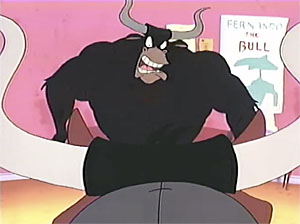 Timon makes a flamboyant entrance into the ring in matador suit, and entertains the crowd with bad stand-up comedy lines about bulls while Pumbaa prepares for his own entrance. But Pumbaa’s entrance will be delayed – by the return of El Toro, who has “beefed” himself up for the event with a crash body-building course to prove he is still the champion. He attempts to dispose of Pumbaa by flushing him down a toilet, then appears in the ring. Timon isn’t quite sure what hit him, and thinks his pal is overacting – until Pumbaa escapes the plumbing and charges in to try to save his friend. Timon goes through the usual delayed reaction at finding himself in the ring with two bulls, and then Timon’s question, “If you’re Pumbaa, then what Pumbaa is THAT Pumbaa?”. The answer is obvious. Our heroes find themselves cornered, and Toro charges from a long distance, allowing for him to engage in transportation changes every time the camera cuts away to view him – from drag racer to diesel truck to streamlined train to Nasa rocket. Pumbaa finally convinces Timon to fight, reminding him of his boasts and that “You’re the brave one.” Timon asks just how he should do it – perform a flamenco dance? This is precisely what he ultimately does, bamboozling the bull similarly to Bugs Bunny’s impromptu dancing in “Bully for Bugs”, while planting snapping mousetraps on his nostrils, smashing clanging cymbals upon his snout, and having Pumbaa blast him in the face with the sour notes of a tuba. Timon backs the bull away from him, using a plunger to prod him instead of a sword, while Pumbaa rolls a cannon up behind the bull, Timon using the plunger end to stuff the bull inside. The cannon is fired, and the toilet plumbing is pushed into the ring, allowing the bull to land in the same predicament in which he had placed Pumbaa. The film quickly comes to a close as our heroes bow before the crowd and are strewn with flowers, Pumbaa shouting, “Ole”.
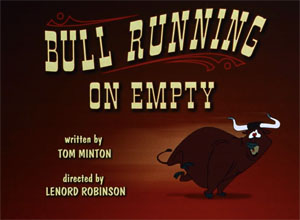 Bull Running on Empty (Warner, The Sylvester and Tweety Mysteries, 11/11/95) is sadly perhaps one of the weakest episodes of this series I have encountered. Made in an early season when one episode spanned the entire half-hour, it provides us with material that would have felt labored in running length even had it been cut to 10 to 12 minutes. Tweety and Hector seem to be given virtually nothing to do (although Tweety inexplicably comes up with a pair of thermal binoculars to give Granny to ultimately locate the stolen item), and Sylvester performs only two functions: mimic for one sequence his “scaredy cat” behavior from the classic cartoon of the same name in observing and keeping out of harms’ way the rest of the gang from the systematic destruction of Granny’s hotel room by saws appearing in the floorboards – and spending the entire remainder of the cartoon running from the bulls of Pamplona. (Sylvester complains, “I’ve heard of a running gag, but this is ridiculous.”) The “mystery”, when unraveled, makes no sense (and not in a funny cartoony way – just isn’t thought out in any manner). A museum artifact known as the Pamplona Periscope is missing, stolen from a hole cut or gnawed through the wooden base of its display case, leading to a crawl space in which only rats seem to reside. A caretaker of the bull ring seems to have had his apartment ransacked, and the ring is left locked, leaving the bulls running in the annual festival with no destination to run to (and free to endlessly pursue Sylvester). Attempts are made to keep Granny out of the way, by sawing her entire hotel room out of the building, then later locking her in the Pamplona public library. All of this boils down to the revealing of a supposedly old (and smelly) adversary of Granny’s – a crook living in the sewers called the Spanish Mole, who has used trained rats to commit theft of the Periscope and his other dirty work. A mere butt from Sylvester’s pack of bulls brings him to justice. It seems that he had disguised himself as the town’s bull ring caretaker for years, living under their noses (yet no one seems to have previously noticed his smell). And just when it seems Granny will reveal the Mole’s master plan to the populace, posing to them the questions why he waited until now to pull his crime, and why he locked the bull ring, Granny performs the ultimate cop-out to reveal how little the writers have thought this through, remarking, “Beats the heck out of me. I was hoping you’d fill me in.” For the quick half-smile this line delivers, it hardly justifies the existence of this episode.
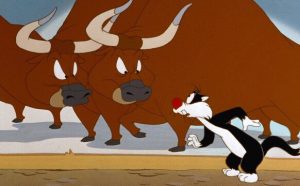 Very few gags instill any life into this lame venture. One decent laugh is the museum curator’s telephone call from a restroom phone to “The World’s Greatest Detective”, a caricature of Sam Spade who is too busy playing tiddly winks with pennies to respond to the call for help. So instead, the curator takes note of graffiti on the restroom tile, one providing a telephone number and reading, “For a good detective, call Granny.” Granny somehow arrives in Spain via a second-hand rocket car, which jets them there in record time, but continues to sputter with knocks and pings after the ignition key is turned off, Granny remarking that it’ll stop – eventually. Of course, upon escaping from Granny’s runaway hotel room, Sylvester winds up with a red blanket, and an alarm clock ready to go off, waking the bulls from exhausted slumber for another day of chasing Sylvester. The bulls ultimately charge through the locked door of the bull ring in seeking out Sylvester, and Tweety and Hector provide Sylvester with a red jogging suit, ensuring that the running will continue round and round the arena ad infinitum.
• An angled print of “Bull Running on Empty” is on Dailymotion
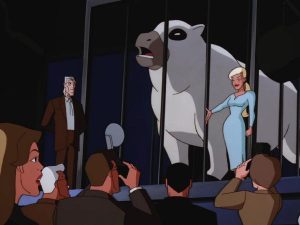
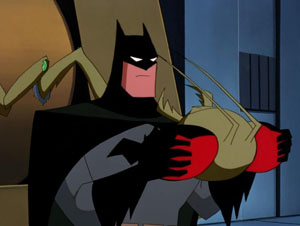 Critters (Warner, Batman, 9/18/98) – One Enoch Brown (affectionately, “Farmer Brown”), an old-timer of country stock who looks and talks like he stepped out of “American Gothic”, but is in reality a highly-skilled biochemist, puts on a presentation with his attractive young country daughter (whom Bullock later refers to as “Elly Mae” for her resemblance to Donna Douglas of The Beverly Hillbillies) at an agricultural expo. Brown presents his solution to world hunger – growth hormones, which have produced a cattle specimen of proportions worthy to provide a meal to King Kong. The bovine is startled by flash photography in the same manner as the legendary ape, and breaks loose, with Commissioner Gordon and Bruce Wayne present in the front row. Bruce finds the creature chasing him, and pulls down a large red theater curtain, which drapes over the beast’s eyes like a cape, causing him to crash into the wall and stun himself, while Brown administers a sedative to leave him dreaming of green pastures. Gordon praises Bruce for his quick thinking, but Bruce covers for his uncharacteristic bravery, informing the Commissioner that he only pulled down the curtain to try to escape through the window.
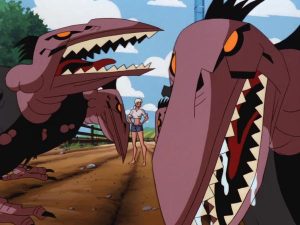 Brown receives an injunction to cease his experiments and remove all live specimens from Gotham. Brown protests that this will mean financial ruin, but the judge responds, “You should have thought of that before you started creating these monsters.” Brown exits the courtroom, muttering, “I’ll give them monsters.” Before long, the city receives a “trial run” of giant aphids (or are they some form of mantis?), genetically altered to be immune to insecticide, but self-destructing to provide a warning. Then, a massed attack of Pterodactyl-like giant chickens, and a rampaging cow and bull bigger than the previous prototype. Batgirl and Robin, on prowl patrol in the batmobile, find themselves in the middle of the stampede. “Holy cow”, utters Robin, as Batgirl responds, “You had to say it.” Batgirl leads the cow into a construction yard, then lassos its legs with a batarang and rope, tripping it into a vat of cement mix. The bull of course invades a china shop, but is lured out by Robin waving his cape in matador fashion and shouting “Hey, Ferdinand.” The bull gives chase, as Robin leaps through the plate glass of a building window, and the bull tries to do the same, getting his head caught within the concrete framing. Batgirl assists, commandeering a garbage truck and driving it up against the bull’s hindquarters to prevent it from extricating itself. Robin looks out upon the scene from an upstairs window, and can’t resist the remark, “That’s a lot of bull.”
 Of course, Brown is behind it all, operating from a new secret island lair outside the city limits. He demands a payoff of 50 million in unmarked bills, or the bugs come back for good. Batman and the Commissioner pull a switch, with most of the bills consisting of blank paper, and one of Batman’s homing devices concealed on the stack. The showdown at the island lair contains no further bullfighting, but attempts to place the bat-trio and Bullock in a silo which is really a rocket for launching into Gotham the hive of mutant bugs. Batman not only tricks one of the insects into ripping open the rocket door so as to allow for an escape of the heroes, but aims the armored car in which the money drop-off was made on a collision course with the rocket doorway before liftoff, sabotaging its flight and killing-off the bugs in the explosion. Brown and his daughter are arrested for an anticipated prison term of 10 to 20, with Bullock offering them the encouraging word that maybe he can find them a nice prison farm.
• Batman’s “Critters” is on DailyMotion
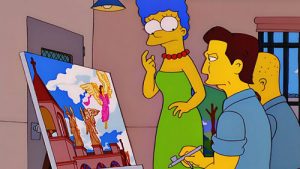 Pokey Mom (Film Roman, The Simpsons, 1/14/01) is one of two Simpsons episodes to include bullfighting. The setup for this one is both brief and odd. While driving hope from an apron festival, Homer spots a sign advertising a prison rodeo at a local penitentiary. The Simpsons attend the event in a front row of the grandstands, watching various inmates get thrown violently in the events. Among them is a prisoner who gets thrown and wedged into the fence on another side of the arena by a bucking bull. Marge wonders where the rodeo clowns are to keep the bull away from the helpless prisoner. They are still in the dressing rooms, fussing over their clown makeup. So Marge flails her arms wildly, trying to attract the bull’s attention away from the inmate. The waving has no effect. Homer calmly informs Marge that to get a bull’s attention, you need to wave something red at them. So, he picks up Lisa in her red dress, and dangles her precariously over the railing, waving her as a ready target for the bull’s wrath. But Homer isn’t a cruel parent, and pulls Lisa back to her seat as the bull’s charge toward them begins. Now, Homer says, all they need to do is wave something in calming blue at the beast to quiet him down. Homer reaches for Bart, but is aghast to find that Bart is not wearing a blue shirt. This is hardly a surprise, as Bart, who always wears red, points out, “Dad, I don’t even OWN a blue shirt.” The bull continues unabated, smashing into the grandstand, knocking Homer over the railing, then head-butting Homer halfway across the prison yard into the side of a guard tower. Unaware of what caused the impact vibration, the guard above responds reflexively, launching a volley of tear gas bombs into the stands, and dispersing the crowd.
The remainder of the show diverts entirely from the subject of bullfighting, splitting into two separate stories. Marge attempts to rehabilitate a prisoner she discovers has natural artistic talent, while Homer attempts to rehabilitate a battered back resulting from the accident. He is referred to a chiropractor who provide only temporary relief, and wants Homer to return for multiple weekly visits over the next three years. Homer discovers a better solution by accidentally falling backwards over the side of a tipped trash can – which instantly sets his vertebrae into proper position. Seeing possibilities in this easy cure, Homer opens his own chiropractic practice, without a license, administering the same treatment to every one of his patients, with miracle results. That is, until two mysterious men express an interest in buying into Homer’s idea, but turn out to be rival chiropractors, who destroy his trash can.
• The best I can find on “Pokey Mom” is a time-compressed vertical set of clips with audio and superimposed narration, on Youtube. Or you can watch it on Disney+.
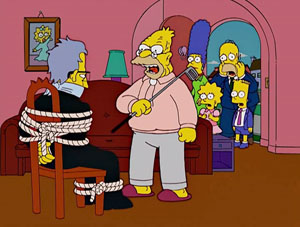 Million Dollar Abie (4/2/06) is another roundabout script that seems to throw together several short and disparate ideas to fill out a half-hour timeslot. Homer sets his mind to spearheading a campaign to bring the NFL’s latest expansion team to Springfield. The campaign works as if by a miracle, and a new stadium is built, the whole town painted in the jersey colors of the soon-to-be Springfield Meltdowns, and all the streets renamed for various football terms and phrases. This renaming disorients the NFL commissioner in finding directions to the stadium to publicly sign the contract, his old road map only showing the street’s old names. He stops at the Simpsons’ house to phone for directions, finding Grandpa Abe to be the only one home who did not go to the stadium. Grandpa becomes mistakenly convinced that the stranger is a hoodlum intending to rob the house and prey on the elderly – so knocks the commissioner out with a blow from a golf club, and keeps him tied and gagged in a chair until late in the evening, when everyone at the stadium has given up waiting and gone home. The family arrives to discover Abe’s blunder, and release the commissioner, only to hear him swear that he will never return to this crazy town – and neither will the expansion team.
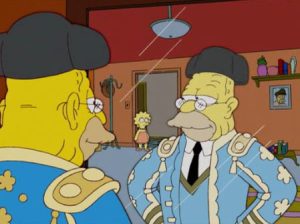 Abe is treated as an outcast by the town for losing the franchise. Another resident of the retirement home suggests he visit a physician specializing in assisted suicides, to put himself out of his misery, as well as satisfy the urges of the town to kill him. Grandpa ultimately consents to death by a suicide computer (looking much like a giant smart phone) to cut off his vital systems. Things do not go according to plan, as the police break in for a raid two minutes before Abe is to expire, announcing that the assisted suicide law has been repealed. The doctor swears, “I’ll kill you” – that is, once the repealing law is itself repealed. Grandpa revives in an emptied room, and thinks he’s dead. He wanders around in a hospital gown, ignoring busy crosstown traffic and taking other risks, believing he has nothing to fear. However, he spots the Simpson family in a restaurant, and thinks Homer or Bart went berserk and killed them all in a murder spree. They inform him that he is not really dead, and are shocked to find that he nearly suicided. But Abe declares he’s through with thoughts of suicide, observing that these few moments when he felt there was nothing to fear were the happiest moments of his life. He resolves to spend the rest of his life in such fearless manner. So, when a town meeting is called to figure out what to do with the empty football stadium, and the proposal is raised to turn it into a bullfighting arena, Abe volunteers to be the town’s first matador.
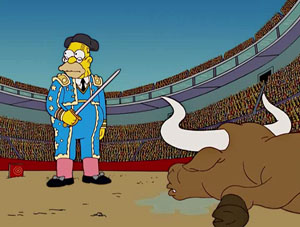 Abe trains in the backyard, using as a bull Bart on a bicycle with a set of horns strapped to the bicycle basket. Abe is too fast for Bart, but Homer is not, and nearly gets speared in the rear while bending over, then turns around to walk right into the horn points, catching him painfully at a key spot between the lower limbs. Lisa, as usual, is completely opposed to the idea – not so much for Grandpa’s safety, but because of the pointless slaughter of helpless bulls. She serenades her pleas for an end to the plan outside the stadium, self-accompanied on Spanish guitar, while the townsfolk merely admire her as cute but ignore altogether her message. Grandpa makes his debut in full matador garb, performs multiple “Veronica” cape passes, and tires the bull out, who lays on the dirt prone and exhausted, while Grandpa, with only momentary hesitancy, follows the crowd’s verdict of “thumbs down” to the bull, and with only the bloodletting kept offscreen, finishes the beast. That night, Grandpa stands admiring himself in the mirror, while Lisa enters, asking him how he could do it. Grandpa explains that for the first time in his life, people were cheering him for what he did, driving him to follow through. Lisa remarks, “I was cheering for you all the time, Grandpa – till now.” As she exits, Grandpa contemplates how she always knows what to say to get to him. At the next bullfight, Grandpa’s performance remains the same as the debut, with the bull again falling to the dirt in exhaustion. But this time, when Grandpa pulls his sword, he tosses it away across the arena, leaving it sticking in the arena fence, then walks to the corrida gates, opening both the main exit and the door holding back all the remaining bulls. Springfield experiences its first-ever running of the bulls, as they stampede down Main Street and everywhere they can find anything red or anyone engaged in selling meat. Only Abe and Lisa rise above the situation, in lawn chairs suspended in mid-air by helium-filled toy balloons. Lisa congratulates Grandpa on turning over a new leaf – but Grandpa’s woes may not be over yet, as two bulls rise into the sky on either side, also suspended by balloons. “Uh oh” moans Grandpa, for an abrupt cut to credits.
There is also a brief “couch gag” bit, with horned couches charging the family like a running of the bulls, from Season 25, episode 16.
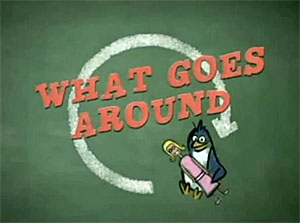 What Goes Around (Dreamworks, The Penguins of Madagascar, 9/19/09) – The Penguins leave the zoo on a secret mission to replace the dolly of a little girl (which they have accidentally caused to be lost down a sewer grating at the zoo). Rico just happens to possess an identical doll as one of his private treasures, and is sweet-talked by Skipper into sacrificing it to prevent the thought of the never-ending weepy-eyes of the little girl. But once the mission is accomplished and the substitute doll left for the little girl to find, the problem remains of returning home cross-town to the zoo – particularly when a psychotic male animal control officer with high-tech capture van spots them on the street, and declaring them strays, says “They’re mine.” (This character may be said to predict the equally determined French female officer who would later appear in Madagascar 3: Europe’s Most Wanted.)
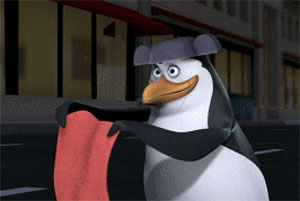
 Throughout the episode, Rico feels dejected that his own dolly was sacrificed to make the girl happy. Private keeps reassuring him that good deeds don’t go unrewarded, and that what goes around, comes around. Yet, the penguins’ luck seems to keep going from bad to worse as the control officer remains hot on their trail. The penguins seem finally cornered, with the van blocking their path to the zoo. The officer wise-cracks that he knows why penguins are from the antarctic – they can’t take the heat. This angers Rico, who coughs up, from his never-ending belly full of useful objects and supplies, a bullfighter’s hat and red cape. He waves the cape before the van, taunting its driver to advance. The van charges Rico at full speed, but the penguin nimbly dodges, again and again, creating a needed diversion. Meanwhile, the other penguins swing down on ropes as the van passes, each of them armed with a monkey wrench. When the van pauses briefly at the end of each charge, the penguins use their wrenches to loosen bolts in the hubs of the van’s wheels. By its final charge, the van’s wheels fall off, capsizing the vehicle on its side. Rico mutters one word of clear dialog: “Ole!”
 While the remainder of the film features no bullfighting, a final stand by the control officer at the zoo gates leads the penguins to notice he is standing just under a pipe connected to the zoo’s sewer line, prompting Rico to spit out a tool large enough to sever the pipe, in hopes of deluging the officer with the pipe’s foul contents. Yet nothing comes out as the pipe is cut. The officer lassos the birds, and calls the office to arrange for a nice tight-fitting cage for the four of them. Then, a rumbling and whistling is heard by Skipper. Looking up, the pipe is vibrating in threatening fashion, and Kowalski realizes something has been blocking the pipe, and it’s gonna blow. Out shoots, with the speed of a bullet, the lost dolly of the little girl, right in the officer’s face. As the doll bounces back, landing at the feet of Rico, the long-anticipated sewer water spews all over the helpless control officer, placing him out of commission. The penguins are able to return to headquarters safely, while the animal control officer is dragged away for causing seven blocks of destruction in his wake, and his remarks about wild penguins treated as the frantic ravings of a lunatic. And Rico hugs his new dolly in replacement of the one he gave up, proving that the universe eventually catches up in providing the return good luck for a deed well done.
• “What Goes Around” can be found, with last shot clipped, at DailyMotion.
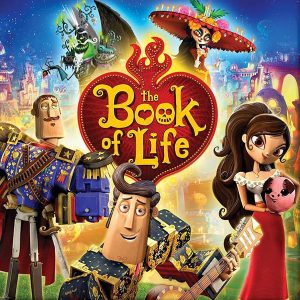 There have been two fairly recent features built on The Day of the Dead. I am not truly into the ins and outs of such cultural mythos, nor can say that I quite understand it. (For example, both films carry a message that to be forgotten by the living is to bring an end to your afterlife. A sentimental idea, but does this mean that no one’s afterlife extends beyond the next generation or so who knew them personally? Or do passed-down stories count as being “remembered”? Furthermore, Pixar’s “Coco” places importance upon having a photograph. So what happened to souls before the invention of the camera? Honestly, these films’ explanations get as mixed-up as details of the life and origins of Santa Claus.) Yet, despite Pixar’s higher budget and more sophisticated technical know-how, I am surprised to say I give the edge in a comparison-test of the two projects to The Book of Life (Fox/Reel FX Animation, 10/17/14). Perhaps it could be said that the simpler visual style of this film has a certain UPA-ish attraction for stylistic and innovative design, making excellent use of color and Mexican art-inspired imagery in both costume and set design. The fashioning of nearly all of its characters as portrayed by wooden puppets from a chest of museum artifacts, together with the transformation of these deliberately-blocky designs into stylized skeletal versions as they visit the realms of the dead, is also quite creative and surprisingly well-executed, not looking cheap despite being an obvious money-saver in computer modeling. Plus, its storyline plays, and homages, more to themes traditional to Mexican cinema than the Pixar film did, and gives us characters who, even if bordering upon traditional stereotypical roles, tweak the stereotypes enough with updated attitudes and humor, and play the roles with enough emotion and soul, to make them more engaging and memorable than the Pixar cast. And, there are enough laughs and plot twists to maintain viewer interest throughout its length, with no real lags (something I found not always true of “Coco”). The effort, while not rising to the level of blockbuster in box office, was financially and artistically viable, doubling its original investment, and earning positive reviews and a Golden Globe nomination. If memory determines the length of afterlife, we can only hope that those who have seen it will keep this film alive considerably long after Coco has fallen to the dust of the forgotten.
The storyline follows a tale related by a shapely museum curator in an exhibit of Mexican cultural artifacts, penned into the Book of Life, an ever-changing magical volume containing the life stories of every soul, of a legendary wager between La Muerte, a skeletal but alluring female spirit who presides over the festive land of the remembered, and her erstwhile paramour, Xibalba, ruler of the deeper and danker land of the forgotten, where those not remembered go to crumble into dust. (Xibalba may be said to be the only character directly derivative from another studio’s work – but perhaps this is a good thing, as he is almost a “dead” ringer for the entertaining Hades from Disney’s “Hercules”). Xibalba wants out of his present job, and wants to swap realms with La Muerte. He apparently got stuck with his job by losing a previous wager, and, knowing La Muerte’s weakness for a good bet, offers another one. Two random child youths (Juaquin and Manolo) are observed on Earth, both sweet upon the same Senorita (Maria). Each of the gambling spirits chooses a boy as their champion, with the bet to see which one will marry Maria. If Xibalba’s boy (Juaquin) wins, realms are swapped between the spirits. If La Muerte’s Manolo wins, Xibalba agrees to stop meddling in human life forever (his only enjoyable pastime). Of course, Xibalba isn’t above cheating.
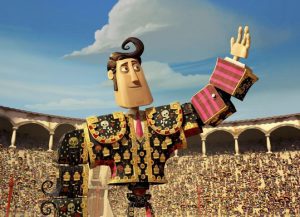 Juaquin aspires to be a soldier and hero like his military ancestors and living father, while Manolo is a gentler kind, torn between his love of playing soulful guitar and his family’s (the Sanchezes) generations-old legacy of being champions (and becoming quickly deceased) in the bull ring. Manolo is fine at learning the moves of the cape – but when to comes to the sword, sees no justification as to why the bull must be killed. Papa and Grandma Sanchez insist upon the old ways, and will show no regret for the conduct of generations of Sanchezes in slaying El Toro in the ring, living by a family motto – “a Sanchez never apologizes.” Maria, an intelligent and spirited girl, likes them both, but seems to show a bit of a edge toward Manolo, who holds more of the key to touching her heart than the brave but slightly self-centered Juaquin and his attempts to impress her with boisterousness and bravado. Even Xibalba soon sees this edge quickly, and decides to even the score, by somehow obtaining custody of a glowing green medal possessing magical protective powers for its possessor, either lost or stolen from a dreaded Mexican bandit cheiftan named El Chakal, and slipping it to Juaquin in a trade while wearing a human disguise. Thus, Juaquin’s success in the future battles he will face is assured.
Time passes, and the three youths grow to maturity, with Maria returning to the village after an extended tutelage in Spain, a natural and self-assured beauty. Juaquin has carved out an impressive military career for himself, with a chest decorated in medals of bravery (though keeping concealed within his uniform the “lucky” green medal obtained long ago). Manolo has been garbed as a matador, but still plays the guitar he had received as a going-away gift from Maria, with a carved inscription on the side telling him to always play from the heart. It is the day of Manolo’s first public bullfight. But, despite his elders’ insistence that he use the sword in the ring as intended, Manolo cannot bring himself to finish the bull, angering the crowd and disgracing the Sanchez name. Only Maria remains behind as the arena empties, the only one appreciating that he stood his moral ground, and listens in the shadows as he consoles himself with a plaintiff soliloquy on guitar. On the opposite battlefront, Juaquin surprises her with an engagement ring and a proposal, but lets slip enough verbal hints that his idea of an ideal married life is for the woman to devote herself solely to pleasing her husband, that Maria realizes he has retained the worst aspects of his self-centered nature. Though her father tries to give consent to Juaquin in advance of her own word, aimed more personally at keeping Juaquin around the village to protect against the bandit attacks of El Chakal, Maria will not give Juaquin an answer, though not locking him out of her life entirely with a no, hoping for the sake of their old friendship that maybe someday he’ll wise up and change his ways.
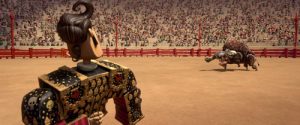 Though utterly disappointed in his son’s performance in the bull ring, Manolo’s father, hearing of Juaquin’s inability to obtain an immediate yes from Maria, convinces Manolo to at least act like a Sanchez by fighting to win the favor of his lady love. Manolo thus serenades at Maria’s window, and asks her to meet him secretly at dawn at a scenic vista on the outskirts of town. Overhearing this and other developments of the day in the shadows is Xibalba, checking in on his bet. He senses disaster if the romantic meeting takes place, and (in what could be said to be another borrowing of a story element from a Disney feature, this time “Aladdin”), transforms a snake-shaped walking staff into a living venomous reptile, to “take care of things”. As dawn breaks and finds the prospective lovers bonding, the snake does its work, biting Maria on the leg before Manolo can defend her. Maria is carried lifeless in Manolo’s arms to her father, and Manolo is blamed for once again not rising to the occasion as a man should have. Manolo remains on the spot, pouring out his emotions in a solo song to the skies at wishing to follow Maria. Who should appear in the same human disguise as before but Xibalba, who asks if he really, from the heart, wants to follow her to the land of the dead. Manolo answers yes, and Xibalba responds, “Done”. The snake reappears, biting Manolo twice.
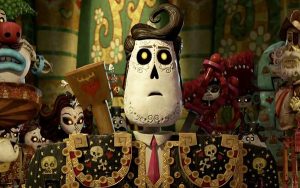 We are transported with Manolo to the happy land of the remembered, where every day is fiesta – but especially today, being the Day of the Dead. A skeletal but recognizable Manolo is united with the entire deceased family line of the Sanchezes, most of whom perished in the ring, but still brag of their exploits. They are disappointed in Manolo, but not in a hard-handed way, and generally accept him, together with the loving arms of Manolo’s deceased Mama, who seems to be the one from which he inherited his soulful heart. But where is Maria? No one seems to know or have seen her. Suggestion is made to see La Muerte about it – but who instead is discovered to be sitting in her throne but Xibalba! Xibalba reveals the stakes of his bet, and declares that La Muerte is now down in permanent exile within the land of the forgotten. Manolo demands to know how Xibalba could have won the bet with Maria dead. Xibalba reveals that his snake requires two bites to make death permanent – only one bite has the “Snow White” effect of a sleeping death, revivable by a love’s first kiss. And Juaquin placed a kiss upon the lifeless form of Maria, bringing her back to life! Although Maria does not truly return the love of Juaquin’s kiss, upon learning of the death of Manolo, she has given her consent to Juaquin to please her father and the town and provide them with a protector against the bandits. So, Xibalba has claimed a win of the bet early, and La Muerte, unknowing of Xibalba’s cheating, has lived up to her side of the bargain. Manolo thus embarks on an unprecedented trek to the land of the forgotten, never survived (or perhaps we should say, accomplished) by any former mortal’s soul from the land of the remembered before his or her time. After facing several harrowing challenges, including a labyrinth with three rolling boulders of the Indiana Jones variety of crushing weight, Manolo is deemed pure of heart and worthy enough to gain entrance past the underworld’s gatekeeper spirit. La Muerte is tipped off, and she and Xibalba do a good job of spitting fire with words and tearing hair between themselves, until Manolo reminds them that this is getting him nowhere in trying to set things right for himself and Maria. The need to return to Earth becomes even more magnified when word reaches them that back at the village, a battle has taken place between Juaquin and some of El Chakal’s men, who have discovered in the battle Juaquin’s possession of the glowing green medal. Chakal has sworn death to the whole village in effort to retrieve the amulet – in which event the Sanchez clan would lose all remembrance among the living (but what about the spectators who knew of their fame in the bull ring?), and descend to the crumbling ranks of the forgotten. Manolo asks to be sent back to Earth, which both La Muerte and Xibalba at first declare out of the question. However, realizing their gambling spirit from their tales of deception, Manolo proposes a wager of his own – that he will face any challenge Xibalba can think up in return for the chance to go back. (It is not entirely clear what would be the penalty if he loses, that he would not already face when his village forgets him.) Xibalba thus zaps into existence a ghostly bull ring, with the Sanchez spirits and other skeletons in attendance, and poses the challenge to Manolo – to fight the spirits of every bull the Sanchez clan slaughtered over the years, all at once. Manolo knows this is likely to be more than he ever thought to bargain for – but with a ring of fire encircling him within the arena, he has little choice but to lift cape and sword, and face the onslaught.
The skeletal bull spirits are released. (It is quite unclear how one is supposed to finish a bull who is already dead – but we can only presume that the sword provided is somehow capable of accomplishing the task in traditional fashion.) Manolo performs not without natural fear, but nevertheless handsomely, in accomplishing pass after pass with his capework as bulls charge him every second from one direction or another. Seeing Manolo doing well, Xibalba ups the odds his own way, by amassing all the bull spirits into one giant, monster bovine towering several stories above Manolo. Manolo continues to perform amazing passes and capework, finally succeeding in causing the bull to crash into an arena wall, temporarily stunned and out cold. The Sanchezes (now including the soul of Manolo’s father, who has just arrived in the underworld by falling as one of the first victims to El Chakal and his bandits above) shout for Manolo to finish the beast. Manolo’s sword, as well as his guitar, have fallen into the dirt in the center of the arena during the battle. As Manolo reaches for the sword, his own reflection in the blade tells him once again that this is simply not his way – and instead, he reaches for the guitar. No, he does not sing off-key like El Kabong. Instead, he composes on the spot a sincere melody from the heart, admitting to all the amassed bull spirits that his family was wrong to have uselessly spilled their blood in the arena, and seeking within their heart forgiveness, through his own heartfelt apology. The bull is disbelieving at first, and butts Manolo and the guitar halfway across the arena. But Manolo still does not fight, and picks up the guitar to resume the apology. The beast charges again until he is nose to nose with Manolo – but hears the song’s words, stops short of collision, and allows Manolo to gently touch the bull’s face with one hand. The bull spirits become pacified, and the massed bull evaporates into what appear to be a flurry of wind-swept autumn leaves, the last one falling to rest in the palm of Manolo’s hand, having the shape of the outline of a heart. Manolo has won the challenge, yet stayed true to his ideals. The spirit of Manolo’s father repeats the old adage to him that “ A Sanchez never apologizes – until now.” A reconciliation occurs between father and son, and Manolo receives the right to return to Earth.
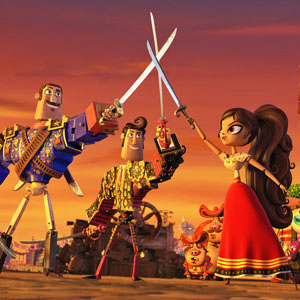 I won’t cover all the details of the final battle, which get a little tricky and leaves the subject of bullfighting. Suffice it to say that Juaquin loses his protective medal to the bandit, exposing that his courage was based on artificial help. Maria stands alone to rally the remaining townsfolk against what seem hopeless odds – but Manolo returns to everyone’s amazement, and stands up to Chakal, stating that he will fight. Chakal laughs uproariously, “You and what army?” An army does indeed arrive – the entire Sanchez clan reincarnated (La Muerte and Xibalba appearing and explaining that this being the Day of the Dead, they have some creative leeway). A battle royal takes place, with Manolo stealing away the magic green medal, which changes hands several times, fortunately being in Manolo’s hands when he and the bandit fall in a fatal blow to the bandit, but from which Manolo miraculously survives. Manolo tosses the amulet to Xibalba, to ensure it will not again fall into mortal hands. Manolo marries Maria, but the bride’s bouquet is caught by Juaquin, giving sign that he won’t be far behind to the alter among the local women. Even a reconciliation takes place between the formerly-bickering La Muerte and Xibalba, as the finale shot reveals that the museum guide telling the tale has really been La Muerte in disguise all the time, and Xibalba takes her in a final romantic embrace for the fade out.
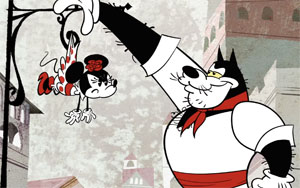 Al Rojo Vivo (translation: “Red Hot”) (Disney, Mickey Mouse Cartoons (TV), 3/27/15 – Dave Wasson, dir.) – A Mickey episode with dialog entirely in Spanish, set in Pamplona, Spain for another running of the bulls. Mickey and Minnie watch on the sidelines, dressed in special white outfits of local design for the occasion – that is, until the wide – er, rear – of Pete looms in front of them to block their view. When Mickey politely asks that Pete step aside, all he receives is a kick in the gut from Pete’s peg leg, landing him in a barrel, and rolling him out into the middle of the street, where he receives a good trampling by a wave of bulls and the members of the crowd running ahead of them. Minnie is hung helplessly by her skirt upon a lamppost, while Pete tries to steal kisses from her. Mickey is peeved, and turns red from head to toe – not a good thing when you are in the middle of a bull run. One of the bulls who has passed him looks over his shoulder, stops, and his eyes turn as red as the color of Mickey’s anatomy. Minnie shouts a warning to Mickey, and the mouse turns white again – this time from fright. The color change is not soon enough to stop the advance of the raging bull, and Mickey flees for his life through the crowd, who parts a wide path for Mickey and the bull to pass.
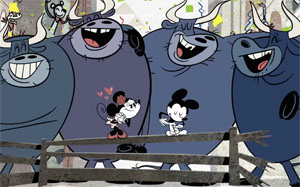 Mickey ducks behind a parked van. However, its color is “Rojo!” (red). The bull’s horns emerge, right through the vehicle’s side. Mickey seeks refuge behind a flower cart – also full of “rojo” flowers. More destruction. Wherever Mickey runs, his surroundings seem to provide such objects as a red motor scooter, a red guitar, etc., and finally a whole neighborhood where almost everything seems to be red. Mickey spots one place in the neighborhood not red – a white door – so performs a transformation act, pulling off his black ears and blending into the scenery in camouflage fashion, while the over-stimulated bull tears up everything else in sight. The bull finally departs, and Mickey returns to his old, casual whistling self. But not for long, as it seems that part of the local festivities include a block-wide food fight – with red tomatoes! Mickey is plastered from head to toe with the dripping redness. The bull returns on cue, chasing Mickey through what seems a tidal wave of tomato juice resulting from the fight. He looks down at himself, to also remark with shock, “Rojo!”, as he too is now dripping red everywhere. Before the bull can ponder the question whether he should charge upon himself, who should backtrack to catch up with him but the herd of other bulls. Mickey and the first bull now race side by side, fleeing from the stampede of angry bovines behind them. Finally, Mickey decides he’s had enough, slams on the brakes, and holds up a cautionary hand to the “red bull” beside him to pause for a moment. Pulling out a large red handkerchief from his pocket, Mickey quickly wipes off the tomato goo from his own person, and then from the bull, restoring them to natural colors. The confused bulls behind them skid to a halt, realizing they have nothing more to charge at. Mickey grabs up all of their tails, and gives the herd a few small judo flips to show them who’s boss, then provides the herd with a new target, tossing the tomato-soaked handkerchief onto Pete. Riding atop the head of the lead bull, Mickey order a charge, and the herd knocks Pete for a loop that sails him entirely out of a long shot of the city skyline. Mickey accepts the applause and cheers of the crowd, and releases Minnie, who plants a kiss on his cheek. The bulls all stand behind them, cheering Mickey as their temporary friend. Mickey begins to blush from the kiss, which might be bad enough as the color red begins to flush through his cheeks. But even worse, the pants of his white outfit fall down, revealing that he is wearing his traditional red pants underneath! A scream from Mickey at knowing what’s to come, and a quick cut to credits.
Adios for now, amigos!