
Turning holiday songs into origin stories is something that Rankin/Bass did best. The Studio translated such popular Christmas songs, such as Rudolph the Red-Nosed Reindeer, Frosty the Snowman, and Santa Claus is Comin’ to Town, into equally popular TV specials.
With this in mind, Here Comes Peter Cottontail was a natural fit for adaptation.
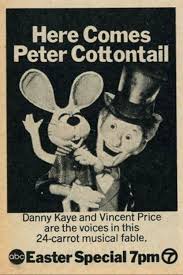 The 1949 song reached Billboard’s Top 10 and became an Easter standard, making it an obvious choice for Rankin/Bass to adapt as a holiday special.
While it may not have had the stamina of Rankin/Bass’ Christmas specials like Rudolph and Frosty, Here Comes Peter Cottontail, celebrating its 55th anniversary this Easter Season, has developed its own following.
The song “Here Comes Peter Cottontail” was written by Steve Nelson and Jack Rollins (who also gave us “Frosty the Snowman), and released on Decca Records in 1950.
Beyond the popular song, another inspiration for Rankin/Bass’ Here Comes Peter Cottontail was the 1957 children’s book, The Easter Bunny That Overslept by Priscilla and Otto Friedrich. Building on these sources, Rankin/Bass stalwart and writing collaborator Romeo Muller penned the script.
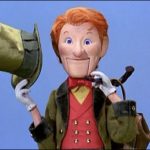
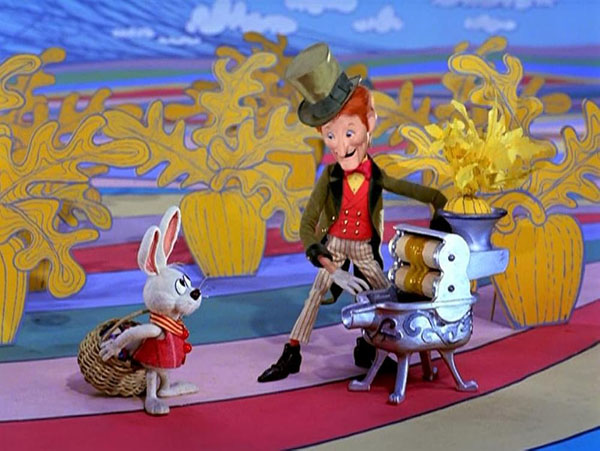
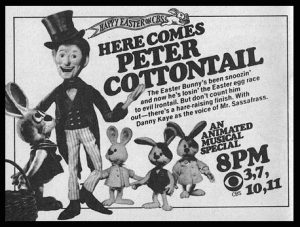
The special, directed by Arthur Rankin, Jr. and Jules Bass, and told in their stop-motion “Animagic” style, is narrated by Seymour S. Sassafrass, voiced by Danny Kaye, a traveling salesman who tells the story of Peter Cottontail. Peter (Casey Kasem) lives in Easter Valley with all the other bunnies. It’s here that all the Easter candy, bonnets, and colored eggs are made.
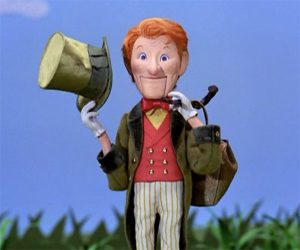 Colonel Wellington (also voiced by Kaye) is retiring as Easter Bunny and chooses Peter as his successor. Villain January Q. Irontail (Vincent Price)—a black-and-grey rabbit with an iron tail—has other ideas.
He proposes a contest between himself and Peter: whoever can deliver the most Easter eggs will become the Easter Bunny. Irontail cheats by allowing Peter to oversleep, and the villainous rabbit delivers all the eggs himself, and becomes the Easter bunny, making chocolate spiders instead of bunnies, and galoshes instead of bonnets.
A dejected Peter leaves April Valley and meets Sassafrass, who gives him his time-traveling “Yestermorrowbile,” piloted by Antoine the caterpillar (Kaye again). This allows Peter to potentially “win back” Easter by travelling to other holidays and attempting to deliver eggs there.
Peter travels to Mother’s Day, July Fourth, Halloween, Thanksgiving, Christmas, Valentine’s Day, and St. Patrick’s Day. He attempts to deliver eggs on each holiday and regain the title of Easter Bunny.
 As narrator for the story, Danny Kaye does excellent work, not just as Sassafrass but also as the Easter Bunny and Antoine. It’s clear from songs like “When You Can’t Get It All Together, Improvise” (one of six written for the special by Jules Bass and Maury Laws) that he was having fun.
This collaboration marked the beginning of a friendship between Kaye and Arthur Rankin.
“Arthur and Danny were kindred spirits. Both liked to travel, eat great food, loved music and art,” said Rick Goldschmidt, official Rankin/Bass historian/biographer and author of such books as The Enchanted World of Rankin/Bass. “They did some traveling together, and Danny even went to the Animagic Studios in Japan to see the animation produced; maybe the only star to do that.”
Building on this partnership, Kaye would go on to work with the Rankin/Bass Studio for what was intended to be a series of specials entitled The Enchanted World of Danny Kaye.
“The first episode was The Emperor’s New Clothes, but the ratings may not have been their best,” noted Rick. “The series may have also been very expensive to produce. Arthur got the author of Mary Poppins, P.L. Travers, to write a script for the series about Jack Frost. Animagic puppets of Punch and Judy were made with a stage set. Jerry Lewis was going to be Punch, with Carol Burnett being Judy. The plan was to re-air previous specials in the series as well.”
Unfortunately, no other specials in the series, beyond 1972’s The Emperor’s New Clothes, ever aired.
 The other casting coup in Peter Cottontail was Vincent Price as Irontail. He emerged as one of Rankin/Bass’ more memorable villains. “Arthur and Jules were so happy with his appearance that they were planning to edit the feature film of Mad Monster Party to an hour TV special and have Vincent host it in Animagic form,” said Rick. He added, “This special would have been part of The Enchanted World of Danny Kaye. Ultimately, they opted to do a new special called Mad, Mad, Mad Monsters for the ABC Saturday Superstar Movie.”
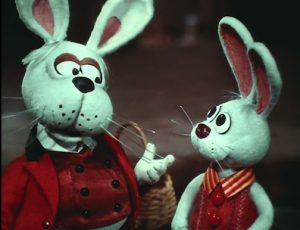
Thanks to Animagic, the artists bring to life all that’s colorful about the holiday and the season in Here Comes Peter Cottontail. The special features bunnies carving chocolate rabbits like great sculptors. It also includes vibrant backdrops, such as the scene where Peter meets Seymour Sassafrass. These beautiful environments were a hallmark of Rankin/Bass.
Originally airing on ABC on April 4, 1971, Here Comes Peter Cottontail may not have had the repeat, seasonal airings of other Rankin/Bass specials, but for many, it’s still required viewing each and every spring.
“I think Rankin/Bass hit their peak in 1970 to ‘71 with Santa Claus is Comin’ to Town and Here Comes Peter Cottontail back-to-back,” said Rick. “Both Laws and Bass soundtracks are of Broadway musical quality. The Animagic never looked better, and Romeo Muller hit his story peak as well.” He added, “It showcases what Rankin/Bass will be forever known for! I think it is an amazing example of their work, and there is nothing better to watch for Easter!”
For more on Here Comes Peter Cottontail, check out Greg Ehrbar’s 2021 article.