
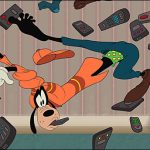

Now, where were we? Ah, yes……
After a six-week hiatus into the world of bullfighting, we return to the universe of cartoons attempting to keep up with popular trends, fads and crazes, or update its characters from their past antiquated ways or personalities unbefitting popular activities into conforming members of society. We re-commence with a few last items from the 60’s, then move into more modern territory from Disney’s move into daytime television-animation and theatrical work post-Roger Rabbit.
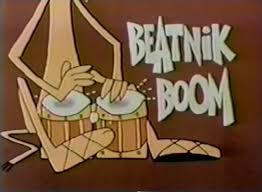 Beatnik Boom/Call Out the Kids (Total Television, King Leonardo and His Short Subjects, circa 1960-61) is a typical two-part tale from the “King and Odie” segments of the show. All seems peaceful in Bongo Congo, with the king’s subjects happy, and industrious in the kingdom’s sole manufacturing enterprise of mass-producing bongo drums, with factory operations humming. This is bad news to resident villain Biggy Rat, who currently finds no ideas for fast moneymaking or promoting his own and his partner Itchy Brother’s rise to power. Itchy, the king’s disreputable sibling, is by nature a confirmed beatnik, and Biggy’s announcement that the two of them are out of money, and may actually have to go to work to eat, receives the same shock-wave of response as if you mentioned the word “work” to Maynard G. Krebbs. Itchy points out that he’s just not the working type, and prefers to spend his day sitting around playing the bongos and spouting beat poetry. In fact, Itchy calls himself the pied piper of poetry. A light goes on (not visualized on screen) inside Biggy’s brain. If the people of the kingdom could be convinced to see life in Itchy’s way, they’d have no use for that lunkhead Leonardo as their ruler, and Itchy could rise to power. So, a speechmaking campaign is set into motion. Itchy pours on the poetry, while Biggy promotes a lifestyle of all play and no work. The idea proves attractive to the Congo’s working class, and soon Itchy is indeed a pied piper to his followers, who abandon factory life and royal occupations in droves to take up bongo playing and poetry writing.
Leonardo becomes painfully aware of the problem when he finds no palace guards within the castle, forcing him to awkwardly open his own throne room doors, and almost wrench his wrist in the process. Royal aide Odie O-Cologne informs him of the bad news of Itchy’s beatnik campaign, and the mass walkout or workers from all occupations. Leonardo calls it the most unheard of thing he’s ever heard of, and ponders the unthinkable thoughts of the financial ruin of the kingdom, and a future of having no one to open doors for him. He and Odie attempt to keep the bongo factory running by trying to operate its assembly-line themselves, but the effort is an utter failure, resulting in both of them being stuffed inside the framework of a newly-minted set of bongos.
Now Biggy rallies the population for the final step – a march on the palace to demand an election, allowing them to cast their votes for Itchy as king. Leonardo observes democratic principles, and agrees to hold the election, nervously waving to his subjects in the belief that they would of course vote for him. But Odie can see where opinion polls are headed, and, despite talking Leonardo into running his own speech-making campaign in attempt to convince the public that work is necessary to the kingdom’s survival, Leonardo is booed resoundingly by the masses of nuevo-beatniks, and final poll results seem to indicate that no one will vote for Leonardo save himself and true-blue Odie.
 However, there is one group of subjects left who retain a soft-spot for Leonardo – even though they are disenfranchised from the right to vote themselves. The kids of the kingdom remain loyal, button-wearing members of the King Leonardo fan club. They alone have the wisdom to realize that, if their parents don’t work, no one will be bringing in any money. And if there’s no money, then no toys! This is a lifestyle that cannot be stood for, and the kids resolve to commence their own emergency campaign to keep Leonardo on the throne. But how to convince their lazy parents to vote for him? The solution becomes an exercise in “monkey see, monkey do” logic. Hiding their fan club buttons to conceal their true allegiances, the kids present a unified transformation within the households of their parents – each doing their best impression of following in the footsteps of the example of their parents, and becoming beatniks too! Little girls won’t pick up their toys, because, like, Daddy-o, that would mean work. Boys won’t deliver to their fathers his favorite pipe. The kids start reciting hip poetry ansd banging out beats on bongos all day, giving their parents no aural peace. So, when election day rolls round, every disgruntled parent in the kingdom votes unanimously for Leonardo. The king wins by a landslide, while Biggy and Itchy’s campaign racks up only two favorable votes – their own. The kids reveal their efforts to Leonardo, who praises them publicly for their loyal support. The factory and palace return to normal industrious operation, while Biggy and Itchy trudge home in disgrace, carrying a few leftovers of their campaign banners and signs. We are left to wonder what will be their next nefarious scheme – until next time.
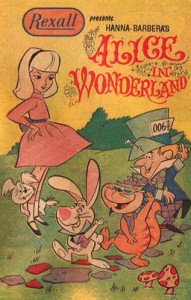 Alice In Wonderland, or What’s a Nice Kid Like You Doing In a Place Like This? (Hanna-Barbera, 5/30/66 – Alex Lovy, dir.), also deserves honorable mention for riding upon the beatnik craze. Although its portrayal of the Cheshire Cat as a goateed, beret-wearing hipster (voiced by Sammy Davis Jr.) is not quite as blatant as several other depictions of beatniks, the cat’s cool lingo comes very close to dialog suitable for Bob Clampett’s Wild Man of Wildsville. As the cat’s smile first appears, Alice remarks that she can’t “see” him. He responds, “Well, I ain’t that sure I flip over you, either.” Alice informs him that she’s not sure she understands him. “That’s all right, little square baby. Not many people dig what I put down.” The cat is not quite up on his Lewis Carroll, surprised when Alice calls him a Cheshire Cat. When Alice informs him that in the book, Carroll’s Alice met a Cheshire Cat”, he rearks “Well, bully for her. I bet that gave her an ‘A’ with the in-crowd.” The Cat declares that he’s really from Jersey City, four generations. Davis then goes on to perform the catchy title number, which was the hit of the hour-long special, and received release as a 45 RPM single on HBR records by Scatman Crothers, and also inclusion in a storyteller album. The film’s script was provided by Bill Dana (Jose Jimenez), and music composed by Charles Strouse and Lee Adams (“Bye Bye Birdie”), which score earned the special an Emmy nomination.
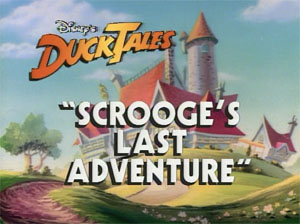 The title Scrooge’s Last Adventure (Disney, Ducktales, 11/17/90) may suggest that this episode was intended to be the wrap-up finale to the original series (although ultimately, a two-part episode, “The Golden Goose”, intended as something of a sequel to the theatrical “Treasure of the Lost Lamp”, aired last). It all starts when a round of Frisbee playing inside the mansion by the nephews wrecks Scrooge’s grandfather’s clock. The nephews take the broken pieces to a clockmaker known as Dr. Quackenshpiel. The clockmaker sees the repair job as hopeless, and at first refuses to even try. Desperate, the boys resort to their standard “Plan B” – throw a mass tantrum on the floor. The clockmaker relents, and promises to try his best. Meanwhile, Scrooge has been out for the day, taking his annual physical checkup – at a free clinic. “A penny scrounged is a penny earned” is Scrooge’s motto when it comes to medical care. Speaking of scrounging, Scrooge thinks he is having a happy day, thanks to a new attachment Gyro Gearloose has installed upon Scrooge’s walking cane – a magnetized tip that allows him to pick up any stray coin found on the street without bending. (A good trick, considering that no U.S. currency is currently made of metal attracted by magnetism – of course, if Scrooge is collecting only wartime steel pennies…) But a telephone call comes in from the “doctor”, informing Scrooge that the “old ticker” has given out, and at most can only run for a few more days. Of course, it is the clockmaker – but Scrooge thinks it is the results of his physical. “What can I do?”, asks a distraught Scrooge. “You could sell me the spare parts”, responds the clockmaker.
Scrooge visits his money bin, accompanied by his “bean counter” Fenton Crackshell (aka Gizmoduck, though he has no opportunity in this episode to revert to his heroic alter-ego). Scrooge worries, knowing that his fortune will be left to the kids, but plagued by the thought of how it can be effectively guarded from the Beagle Boys when he is no longer around. Fenton talks Scrooge into the world of computerized on-line banking to manage his financial affairs and monetary transactions. This is something new and foreign to Scrooge’s way of thinking. (Indeed, one could imagine Scrooge as feeling more comfortable having his accounting performed by scriveners with quill pens.) But, for the sake of the security of his nephews, he agrees to have the money bin drained and deposited in an online account – after one last swim through it for old times sake. The operation takes every truck in the county, but is accomplished. Fenton takes Scrooge to his computer console, and opens up a site where he begins to demonstrate how Scrooge’s money can be shifted from account to account and from investment to investment. Suddenly, upon another push of a button, the screen turns to static, and Fenton begins to perspire profusely – more that Mrs. Beakly at a disco. A one-in-a billion glitch has occurred, and all record of Scrooge’s money has disappeared. Fenton jiggles the keys, slams the monitor, but nothing changes. Scrooge refuses to be wiped out by technology and die a pauper. He and Fenton consult Gyro for a solution. In a bend of scientific possibility closely mirroring Disney’s “Tron” series, Gyro proposes the radical and risky idea of going into the computer to find the source of the problem – converted into electronic impulses and uploaded from a floppy disc. (Boy, Gyro’s floppies must have a lot more memory capacity than the ones I used to use on old systems.) Fenton begs to go along to make up for his disastrous ideas, but Scrooge refuses to subject him to the risks – until Fenton resorts to the nephews’ “Plan B”, and also throws a crying tantrum on the floor. Thus begins a trek into the electronic universe, as Gyro drops both of them into a digital world, propelled by a strange conveyance he refers to as a “hard drive”, a device steered by Fenton juggling cutouts of geometric shapes upon a magnetic dashboard like Colorforms. Gyro tells them to look for the glitch hiding out in a bad sector, and a black area of computer space punctuated by synthetic lightning flashes looks about as bad as Scrooge has ever seen.
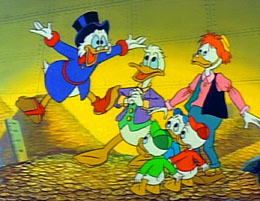 While they are steering a course toward the sector, they are unaware that Gyro has taken a quick break from the screen to grab himself a sandwich, and the nephews have entered Scrooge’s office in his absence, carrying a video game cartridge which Scrooge has previously allowed them to play on his computer. Upon inserting the game, the scenery around Scrooge and Fenton changes abruptly – to a point-of-view inside the pill-filled maze of an ersatz Pac-Man game. However, Pac is nowhere to be found. Instead, Fenton and Scrooge are the targets, and the ghosts are replaced by one huge creature that somewhat resembles a monstrous whale – whom, upon sighting it, Fenton dubs “Moby Glitch”. The chase is on, and Gyro returns to find what the boys have done, the boys not understanding why images of Scrooge and Fenton are appearing in their game. Gyro informs the boys that the images are real, but the boys can see that Fenton and Scrooge have become cornered at one end of the maze. Having no way to steer them into a route of escape, one of the nephews does what he always does when about to lose a video game – pull the plug. The screen goes blank, and Gyro panics that the two voyagers may be lost forever. But inside the system, Fenton and Scrooge somehow re-materialize on board the hard drive, with the maze and all boundaries to their travel disintegrated. As Gyro reconnects the computer’s power and frantically searches the system for them, he somehow determines that the voyagers and the glitch have found a means of escaping the system through the phone modem, and into the telephone wires leading to the mansion. Gyro describes it as trying to “reach out and touch someone” – an old telephone company slogan.
A return to the viewpoint of our digital heroes finds them pursuing the glitch within a telephone cable, which looks more like a never-ending canal tunnel on the inside. The hard drive has taken substantial damage, and Fenton’s geometrical maneuvering isn’t accomplishing much with all gears dropping off except reverse. The conveyance finally falls apart, and the glitch turns to battle them. Fenton, upon Scrooge’s orders, puts up a fight against the beast, but is swallowed whole by it. Scrooge sees to be next – but the voice of Gyro reverberates through the cable, as he attempts to contact them through the telephone in Scrooge’s office. Gyro informs Scrooge that something magnetic might disrupt the glitch – and Scrooge remembers the new tip of his walking cane. Scrooge thus allows the beast to swallow him, then points the tip of his cane at him from the inside. BLAMMO! The beast disintegrates, and Fenton and Scrooge are saved. Not only that, but a sea of dollar signs emits from where the glitch had been – the digital dollars the beast had swallowed. Gyro reverses his electrical impulse program, re-routing the end result to a monitor within Scrooge’s money bin. In a miracle which could only happen in a cartoon, Scrooge, Fenton, and the entire former contents of the money bin burst out of the monitor to full 3-dimensional life, and everything is restored to what it was before. All except Scrooge, who reveals to the boys that he isn’t back for long, and relates to them the bad news he was given from the “doctor”. The boys quickly realize what “doctor” he is talking about, and a confession is made about their busting the clock. Scrooge is not so much mad about the clock, but at having risked his life and his fortune all for no good reason – and breaks into a Donald Duck-like quacking tantrum on the floor. One of the nephews remarks to the others that he didn’t know their uncle knew about “Plan B”.
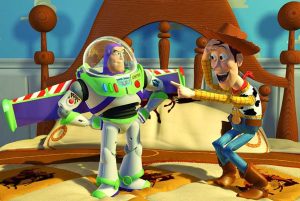 It might also be said that Pixar’s Toy Story (11/22/95) constitutes a tale of getting with the times. Classic TV Western cowboy doll Woody comes face-to-face with the future, when Christmas brings the household of his boy, Andy, the top-flight superstar toy of Buzz Lightyear of Star Command. Buzz is not aware of the true meaning for his existence – to be a child’s plaything – and has the notion in his head that he is the real deal – a genuine Space Ranger, even equipped with the power to fly. His winged space-suit does not display genuine aerodynamics, and despite Buzz’s impressive demonstration of diving into the air and bouncing gracefully off various objects in the playroom, Woody calls his bluff by insisting that Buzz can’t fly – he is only “falling, with style.” Woody further repeatedly confronts Buzz with the reality check, “You are a toy!”, merely leaving Buzz with the prevailing impression that Woody isn’t well. When Buzz becomes Andy’s new favorite, even receiving a marker-pen inscription of Andy’s name that used to be reserved for the sole of Woody’s boot, Woody seems to secretly want nothing more than the ouster of the psycho space ranger from the playroom. An accidental mishap causes Buzz to fall out the window – and circumstances make it appear to the rest of the toys in the playroom that Woody pushed him. The toys gang up upon the innocent, if not entirely unpleased, Woody, and Woody is forced to exit the house also, determined to embark on a mission to rescue Buzz and clear his own name. The now-iconic tale thus weaves its way through many exciting misadventures, including a visit to the ever-popular “Pizza Planet” outer-space themed kiddie restaurant (a not-so-subtle send-up of Chuck-E-Cheese’s), and the chamber of horrors that is the room of next-door-neighbor boy, Sid the Toy Destroyer. In the course of it, Buzz learns from an on-the-air TV advertisement that he is one of thousands of dolls of his type, and that a disclaimer in the ad notes that he cannot really fly. Woody softens toward him, and reassures him that the role of a toy is equally important to any old space ranger, boosting Buzz’s shattered morale, and making him determined to get home to their boy, Andy, to serve their proper purpose. Of course, Sid is defeated (Buzz even leaning how to use his “falling with style” to the mutual advantage of himself and Sid’s other captive toys), and Buzz and Woody return to the playroom triumphantly, with a new-found respect and comradery toward one another. Maybe past and present heroes can co-exist, after all.
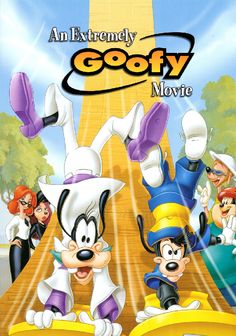 An Extremely Goofy Movie (2/29/00, direct to video), noted by one of our bloggers, receives honorable mention, though perhaps not precisely fitting the theme of this article series in its primarily-remembered content, as Goofy’s extended musical performance as a surprise whiz at disco dancing is not a transformation aimed at getting with the times, but a throwback to Goofy being himself, to impress a college librarian who is from his era and hooked on the same fads from the past as Goofy is. Perhaps the film’s main plotline more closely matches-up with our theme. Max is off to college with P.J., leaving Goofy with the feeling of an empty nest. Goofy’s mind wanders thinking of Max while doing his work at a toy factory, resulting in an assembly-line disaster that loses him his job. Finding no new jobs of sufficient stature available without a college degree, and Goof being one year short of education to obtain same, Goofy enrolls in the same college as Max and P.J., and tries to fit in with student society and hijinks. Of course, Goofy gets mixed up in the boys’ Extreme Sports competition against a rival fraternity, and has to deal with the realization that his son thinks he is ruining everything, but an ultimate reconciliation results when the chips are down. Meanwhile, Goofy finds new love in the form of the librarian, also mired in love of the past era that Goofy finds his comfort zone. Goofy and Max bring home the gold in the competition, and Goof receives his diploma – only to perplex Max as to what next year will bring, when Goof’s new sheepskin qualifies him for a good job right on campus next year. Another sidelight of the film, unexplained as to how she happens to exist unchanged by modern times, is the setting of a coffee house which is a favorite campus haunt, operated by a black-outfitted and bereted female proprietor who is 100% beatnik and a dean of cool poetry. P.J. finds budding romance with her, and begins to expound verse of a similar nature that even the girl can dig the most. Go fig, ya dig?
 Disney’s Mickey Mouse Works marked the studio’s first full-scale revival of its cast of classic theatrical characters from the golden age of short subjects. While many episodes presented the characters in classic-style story situations which could have as easily fit into the time periods of the 40’s and ‘50’s, some would pit the characters against new and more modern settings and predicaments which did not yet exist in their glory days, attempting to keep the characters fresh and up-to-date. Of course, this didn’t mean that their personalities naturally meshed with their contemporary challenges, and culture shock could often contribute to the comedy of their attempts to face uncharted waters.
Computer.don (Disney, Mickey Mouse Works, 4/15/00) – Donald Duck is a dweeb. Don’t take my word for it – it’s everybody’s opinion – except for Donald himself. His houseboat is full of antiquated and obsolete objects that serve the functions of everyday necessities. His lighting is provided by a kerosene lamp. His wall clock is a sundial. His refrigerator is a 1930’s ice box. (Even iceman Goofy, who seems to have Donald as the last customer left on his list, remarks that Donald must be the only one on Earth to still have one of these.) And Donald does his math calculations on an abacus, which he thinks of as his computer. Daisy Duck, on the other hand, is with the modern trends, and owns a cell phone, computer, fax, and has just gotten e-mail (all cutting-edge when this cartoon was made). She calls up Donald (on his rotary phone), and asks him to sent her an email and a picture on the computer. “You do have a computer?”, she asks in afterthought, her tone indicating that, unfortunately, she can predict the answer. Finding Donald to be as backwards as ever, she demands that he purchase a computer, or she’ll look for a new, modern boyfriend – instead of a dweeb. Donald has visions running through his head of Daisy romancing a flashy-metal duck android, and so, against all his basic instincts, vows to purchase a computer. Of course, the computer store won’t take phone orders without punching in digits – something impossible on Donald’s rotary phone – so he is forced to march to the store and manually lug the heavy box of components home.
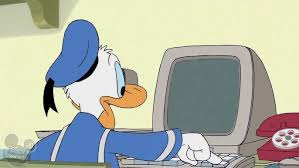 As Donald pops the top of the packed crate open, a speaker on a pole pops out of the packing materials, speaking to him to congratulate him on his purchase, and asking him to speak his name into a microphone for voice recognition. As clearly as his natural speech pattern will allow, our hero states into the microphone “Donald”. The computer misinterprets the name as “Duo”. Off to a great start. Now for the unpacking. Various drives (including a floppy drive consisting of a soggy wilting pizza, and a zap drive which zaps Donald electrically into charred blackness), plus a keyboard, circuit board, surfboard, and ironing board, and a mouse (Mickey in a crate, complaining about not belonging in this picture). Some assembly required. After scanning through instruction charts, dozens of manuals, glossaries, etc., the speaker finally informs the baffled duck that if he still can’t find the proper plug-in, his model requires a mail-away for additional instructions not included with the set. The frustrated fowl tosses the whole contents into the trash can, until another call from Daisy, accompanied by phantom batting of flirtatious eyelashes, puts Donald back on track again. Donald inverts the trash can and dumps the contents back out, which rebound off the floor, and miraculously bounce into place on Donald’s desk, attached and fully assembled. “Now, that’s more like it”, says the surprised duck.
The computer screen says Welcome, but a first push of a keyboard button initiates a start-up sequence. The screen images change from spinning clock hands to flipping calendar pages to barely-crawling progress bars, with mottos flashing on the screen such as “Patience is a virtue”. (This sequence is quite similar to the endless roll of instructions, arrows and directional hands seen as Goofy winds his camera film to photo 1 in the classic Disney theatrical, “Hold That Pose”.) Dawn breaks the next day before startup is completed. Daisy phones again, complaining that she didn’t receive Donald’s email. “I’m working on it”, shouts the exasperated duck.
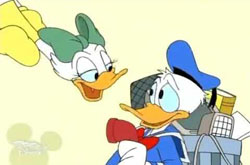 Donald searches an old high-school yearbook for a photo of himself to send to Daisy. He encounters an atrocious one of himself in an Afro-feather-do, and is sure that’s not the one to send. But the computer scanner makes the decision for him, choosing that moment to suck all the pages out of the yearbook into its rollers. Donald engages in a tug-of-war with the machine over the last page – and is dragged into the scanner himself. What follows may be the first rendering of the duck in CGI, as he appears three-dimensionally on the screen of the computer monitor, and is pursued through a maze of icons by the selector arrow, which seems to have a determined goal of spearing Donald in the rear end, changing the color of his image with every hit. At one point, a drop-down selection menu appears for the pointer to choose from, with options including Smash Duck, Erase Duck, Pinch Duck, Punch Duck, Chase Duck, Pound Duck, Crush Duck, Flip Duck, Flop Duck, Annoy Duck, and Stomp Duck. Does it really make a difference which one of these options is selected? Donald hides out in the computer trash bin, but is selected from within by the arrow, which drag-clicks him over to the printer icon. Back in the real world, Donald rolls off the presses flat as a pancake, but pops back to his normal form, exhausted. Donald again tries to dump all the components into the trash can, but Daisy walks in, pleased that she received his email. How, thinks Donald, as Daisy presses the keyboard, revealing on the monitor that the machine self-sent Donald’s awful photo to Daisy. Daisy has sat up a web-site (appropriate for someone with webbed feet) displaying Donald’s image, which has already received a million hits. “What a dweeb”, remarks Daisy at the photo, but then throws her arms around Donald and kisses him, adding, “…but you’re my dweeb.” Donald gets woozy from the kiss, just as the computer speaker pops up again, to add “And you’re my dweeb, too – Duo!” Donald faints from exhaustion and frustration, for the iris out.
How To Be a Gentleman (Mickey Mouse Works, Goofy, 12/16/00) – Goofy faces the same dilemma addressed on multiple occasions by Fred Flintstone – how to gain membership in the local Country Club? Perhaps the Goof is even a more unlikely candidate for membership than the cave man. The Goof declares, “I’m country”, pulling out a Stetson hat to wear, “And I carry a club, too.” His entrance with both items gets him swiftly booted through the closed wooden door. But the ever-present narrator will give it a go to try and shape this refugee from the farm into a polished gentleman.
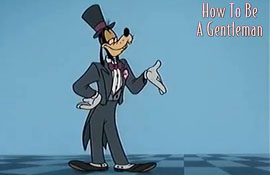 First, the attire. Goofy’s outfit disappears as if it were the flat raiments of a paper doll, and just as swiftly, a tuxedo takes its place. Goof turns away from the camera, revealing himself still visible in shorts on the backside of the paper cutout, and remarks, “Must be half-price.” Diction lessons have him reciting tongue twisters (presented with a bouncing ball over printed letters, confusing to Goofy as the words are not facing him, so he turns the words around backwards on the screen, then winds up bouncing atop the moving ball). He also practices greetings to a queen – lousing up the words with the classic spoonerism, “Queer old Dean”, and getting “crowned” by the queen’s scepter. His eating habits are to devour everything. Even when told not to use his hands, he still finishes everything in front of him – even devouring the table and the metal candelabra centerpiece (plenty of iron). A lesson in poise has Goofy challenging the narrator to “Do your worst”, resulting in him being smacked by an angry lady’s handbag, bitten by a dog, hit by a falling safe, speared by a knight in armor, run over by an express train, swamped by a tidal wave, and blown up by a cartoon bomb. He remains cool as a cucumber – though he falls apart into segments. He is finally ready for society – excepting forgetting to put on his pants as he re-enters the club – and again gets tossed out on his ear. The nrrator can’t believe he would need to remind Goofy about the trousers, and gives up on the whole idea, remarking, “What was I thinking? You’re Goofy!” Irritated no end, Goofy pulls out his wooden club again, and in POV shot from the narrator’s vantage point, Goofy approaches the camera, and lands three shattering blows upon whoever is behind it. The camera and narrator collapse sideways to the ground, as Goof walks away from our vantage point, while the narrator moans, “Now, that’s what I call a gentleman’s club.”
Mickey Mouse Works would become House of Mouse, newly frameworked within the walls of Mickey’s swank night club in downtown Toontown for toons only. Individual cartoons elements, however, would still maintain the classic six to seven minute framework. One of these was How To Be Groovy, Cool, and Fly (House of Mouse, Goofy, 1/27/01), which presents a veritable Goofy fashion show, transcending us through all manner of male fashion trends from the British Invasion of the 60’s on through the new millennium. It begins with Goofy is his usual attire, as the narrator declares him out-of-date, and looking like his Mama dressed him. For perhaps the only time in the Goofy universe, we actually get a visit from Goofy’s Mama (an overweight likeness of himself in a dress, with a possible June Foray voice similar to Ma Beagle), who finishes the job by stating, “Don’t forget your hat. Hyulk!” The narrator magically removes all of Goofy’s uncool garments, reducing him to his underwear, then re-garbs him in the trend-setting styles of several generations. Goofy ranges from drum player in a rock band with Beatle wig, to hippie, to laid-back Afro, to disco fever (accompanied by Donald doing the Disco Duck), to the sci-fi look (entering in an outfit and hairdo that look like Star Wars’ Princess Leia, then cutting a wire holding up a spotlight above his head with a swing of his light saber, dropping the spotlight framing onto his head, in which he breathes heavily as if in the mask of Darth Vader). A running gag has ecstatic girls mob the “cool” Goofy while in various guises, tearing at his clothes like rock groupies, leaving the Goof in underwear again. When one style requires the added gear of a swinging sports car, the girls mob him again, not only taking his clothes, but the tires, hood, and doors of the car as well. Finally, we reach the contemporary current era. Goofy appears again, back in his old standard outfit. The narrator mutters “No, no”, believing that Goofy didn’t get the message of the whole cartoon. To his and our surprise, Mickey and Donald pass through the shot – wearing outfits identical to Goofy’s! And so is everyone else. The narrator is forced to admit that in the world of fashion, everything old is new, and congratulates Goofy on being in perfect style – as the usual mob of girls enter, all dressed in Goofy outfits, and reduce the Goof to underwear again.
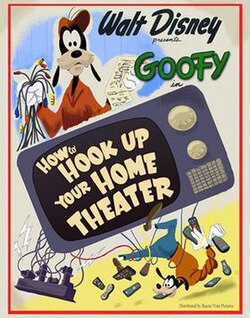 An impressive encounter with the world of modern technology is the late Disney theatrical short, How to Hook Up Your Home Theater (12/21/07), starring Goofy, in a well-animated follow-up to his classic “How To” shorts of the past. Beginning with credits copying the traditional sunburst and burlap main titles of old, and the 1950’s Goofy theme and portions of the march from How To Play Football reorchestrated, we are invited by the narrator to witness the age-old tradition of “watching the big game”. Our first scenes are depicted in full color and widescreen live from the football stadium, with cheering squad members in lettered sweaters mistakenly spelling out “Go Meat” instead of “Go Team” until they get their standing placement rearranged. But then we see the game as Goofy is seeing it from his living room – on a portable black-and-white set with six-inch screen, using rabbit-ear antennae with makeshift repairs including the addition of a coat hanger, a pie tin (with one slice of pie still on it), and a partially crushed soda can empty. A fly lands on the screen, and a disgruntled Goofy calls out, “Down in front”. Then, the reception goes bad. As Goofy struggles to shake the miniature set in his bare hands, he happens to glance out the living room window, to witness two moving men carrying into the house next door a humongous packing crate from the van of a home theater system store. Goofy’s eyes turn into miniature footballs, as he envisions what it would be like to own one of these technological marvels. The narrator describes the experience as like being right on the field, and in Goofy’s daydream, he is in the stadium, carrying the ball while sitting in his easy chair, while the team propels him across the goal line for a touchdown. That’s settled – Goofy must have one of these babies.
The Goof travels to a high-tech wonderland – the local mega-store “Shiny Stuff” (bearing a surprisingly close resemblance to the average “Best Buy” outlet, right down to the sign’s color). Goof is instructed while floating on an imaginary cloud to pick up a few “essentials” – the DVD, the CD, the VHS, the LMNOP(????), and various others until he carries a tower of components. And don’t forget the batteries – they’re not included. This final weight brings Goof crashing down to Earth, but the components land in a convenient shopping basket. Now Goof begins passing flat-screen TV sets of various sizes, getting more excited as the screens grow larger. He finally finds himself facing a screen that seems the width and height of the whole department. Embracing the screen, Goofy affectionately whispers, “I LOVE you.”
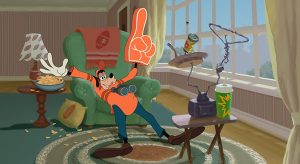 Delivery day! That is, any time between the hours of 8 a.m. and 5 p.m. Goofy waits at the window of his home, anxiously waving a pennant and a foam “we’re #1″ oversized hand. He waits – and waits – and waits – falling asleep until dawn of the next day, when the van arrives, shaking the whole house. The vibrations straighten a painting on the wall of the leaning tower of Pisa, which Goofy corrects to its proper leaning angle. Delivery is made with the movers’ customary precision – as they use a derrick to lift the whole house off its foundation, push the giant packing crates into the living room area with a bulldozer, then drop the house back into place. Goofy opens the top of the largest crate, and an exterior view of the home shows an explosion from all windows and doors of packing peanuts. Goof is swept out into the yard atop them, all stuck to his person by static electricity. He sticks a finger into his mouth and blows hard, propelling the peanuts away from the air emitting from his ears – only to have them stick right back upon him again as soon as he runs out of air.
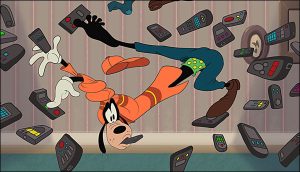 The wires need to be attached. The plastic bubble in which the package of cables is contained refuses to bust open – not even under hammer blows – until a stray drop of Goofy’s perspiration somehow dissolves it, spewing wires everywhere. They all have color-coded connectors – on the back of the set, facing the wall. Goofy is forced to cut a gaping hole in the wall with a power saw, then another to walk through to drag the cables outside to connect them. Anything that’s left sticking out when he puts the wall panel back in place is cut off with the same power saw. A diagram depicts the proper placement of the multitude of sound speakers, guaranteed to produce eventual deafness, especially by means of the sub-woofer, whose tone cracks our camera lens. Goofy suspends, glues, props up, and otherwise places speakers everywhere, knocking away the contents of a fireplace mantel (including a framed portrait of Walt Disney), dropping a speaker into a goldfish bowl, and stuffing another into the mounted head of a moose. When completed, Goofy is hanging upside down from the chandelier, dangling from the speaker cords. But, for Pete’s sake, says the narrator, it’s time for the big game! Goofy can hardly tell, as he’s yet to set any of the timers on the various devices, which all flash 12:00 like an old VCR. He races for a remote – but has no idea which one to push out of a table-load of such controls for the various equipment. As his arms wave frantically, trying to activate everything all at once, the narrator shouts, “WAIT! You DID purchase a universal remote?” Goofy, with one remote stuffed in his mouth, mumbles, “Uh huh.” Under a dome of glass (resembling the one housing the magic rose in “Beauty and the Beast”) rests the magical device, with one simple large button bearing yellow and black caution stripes like an industrial panic button. With a flourish and a flush of anticipation, Goofy presses it. The whole house explodes! Goof and his easy chair are rocketed into the sky, then land with a thud in a dust cloud, along with what appears to be the screen of the TV set. As the dust clears, Goof’s eyes widen with the grandeur and clarity of the image he is seeing. The entire offensive line of the football team is charging straight at the screen and the Goof – but things are a bit more realistic than Goofy bargained for, as he and the empty frame of the TV screen have actually landed on the football field itself. The players rush through the empty screen frame, picking up Goofy and his chair, and toss him around as the defensive line meets them in collision from the opposite direction. Goofy winds up in the middle of a dog pile of players, with the football stuck in his mouth, and a referee throwing a penalty flag across his face. Goofy spits out the football, with one eye blackened, but smiles, closing with the observation to the audience, “It’s almost like bein’ there!”
It appear that this year, yet another Pixar film may join the ranks of eligibility for inclusion in this article series. Toy Story 5 has chosen to revive the franchise which most thought finished with the last picture, and its trailer suggests that the revival may not be merely a forced idea to cash in on some new bucks, but based on a legitimate and contemporary concept unexplored by the series, which many a parent has had to face with their real-life offspring. How do the three-dimensional playthings of old deal with the advent of the computer age, when smart pads and hand-held devices take the place of real-life gameplay and draw the kids into the colorful, flashing and immersing 2D world as opposed to creative play and use of the imagination in place of the frenetic action on the screen? I know of several households who wish they had an easy answer to this question, and I’m sure there are millions of others like them. “I’m losing her”, states Jessie the cowgirl in one of the trailer’s scenes, and I swear I’ve heard the same words from the parents. How Woody, Buzz, and the others will wage war against the “Lily Pad” that begins the conflict remains to be disclosed – and we can only hope the writers have thought of a solution as ingeniously creative as the franchise’s first venture, which might present some level of answer and guidance to the real world parents and kids watching so as to spark discussion, and perhaps reach to the inner child within both the little ones and the big ones alike to develop a mutual understanding that playtime should be more than spoon-fed images off a screen, but something that can, between the needed relaxation, reach and develop both the mind and imaginative soul of the player as well.
NEXT WEEK: Another go-round with modern trends.