
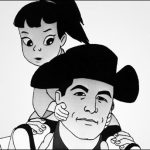
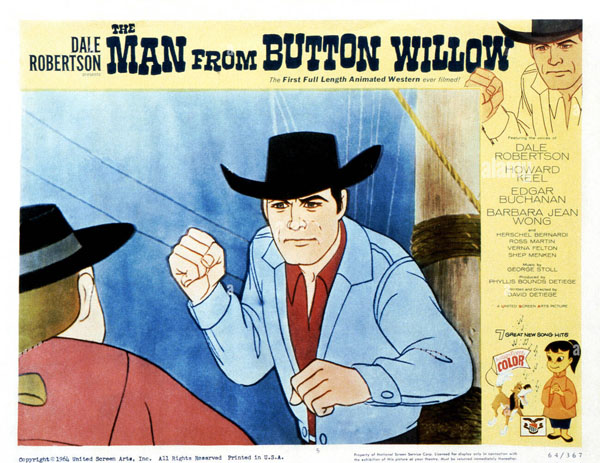
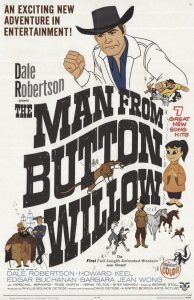
On April 3, 1965, a low point in American animated films hit the theaters. Advertised on its poster was the tagline, “The Most Delightful Animated Adventure Since Snow White.” This audacious claim would have been more truthful if it had been a comparison between a third-grader’s crayon art and a Picasso, but hey, it did have one honest word: it was animated.
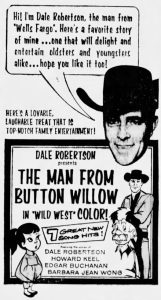 The Man From Buttton Willow, produced by film and TV cowboy star Dale Robertson, left itself wide open with that tagline, and it gets everything it deserves. Neither delightful nor adventurous, this disaster takes its place beside Foodfight, Arctic Dogs, and that great animated epic, Happily Ever After, which spelled the end for Filmation. Button Willow is 81 minutes of boring, poorly produced animation that might have an actual running time of 45 minutes if one were to edit out all the folderol involving humanized animals, the terrible “musical numbers,” and the reused animation cycles.
Let’s get down to business. The story involves Justin Eagle, (Dale Robertson) purportedly the very first “U.S. Agent”, investigating the machinations of the evil Montgomery Blaine and his accomplice, The Whip. These two, readily identifiable by their Scooby Doo – type evil visages, have been buying up the route for the transcontinental railroad and overcharging the government for the land. Oh yeah, they have been driving settlers off and burning their homes, a terrible thing to do since the inhabitants of Button Willow do nothing except walk down an idealized Western street and attend church. We know that Blaine is a scoundrel because he blows smoke rings from his cigar into our faces.
Aha! The good Senator Freeman has evidence of Blaine’s misdeeds! Before he can warn the Senate, the bad dudes kidnap Freeman in San Francisco, which is on the other side of the country from Washington, where the Senate is, but hey. They dump him onto a ship, although nobody knows which one, planning to permanently silence him eventually.
 It’s Justin Eagle to the rescue, or at least after a stultifying, absolutely deadly period of doing farm chores and relating to his ranch animals and being attentive to his Japanese adopted little girl Stormy, who speaks in malformed English and attaches the suffix – “san” to everyone’s name. We learn in an awful song whose lyrics consist mostly of “Pardon Me, Ma’am” why Justin’s loyal ranch hand, Jeremiah “Sorry” Baker, never married, which is irrelevant to anything in the plot.
Jeremiah and Justin are both incredibly stupid; when one of their mares, Savannah, is about to foal, they believe she is sick, panic, call the vet, and wait worriedly outside the stall until they get the good news and celebrate! You dunderheads! You own a freakin’ ranch, and you couldn’t figure out that one of your mares was preggers? Anyway, this segues into a lengthy scene of the cutie foal. The dreadful soundtrack launches into the praiseful song, “Savannah,” which consists of that single name repeated endlessly.
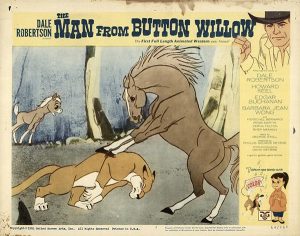
Of course, the foal runs away into the mountains, pursued by Savannah’s stud Rebel, Justin’s dog Shady, and pet skunk Alfie. A cougar attacks, and Shady is knocked off a cliff in a fall that Wile E. Coyote might have envied, but of course the kindly vet resurrects him as Stormy prays. We are now at least 100,000 miles off the alleged plot of this tale.
 Oh, yeah, Justin is in San Francisco, where he gets shanghaied and ends up on the same boat as Senator Freeman (remember him?) With the help of fellow prisoner Andy (Ross Martin), who boasts the worst Swedish accent since Pat Harrington Jr. voiced Lars in the Filmation series Journey to the Center of the Earth, Justin defeats the entire crew in the only noticeable “action/adventure” sequence in the film. They sail back to San Francisco. Justin goes home. Blaine and the Whip go to jail. Das Ende.
We’ve been over the music. Henry Mancini was allegedly a contributor to George Stoll and Robert Van Epps score, perhaps on a day when Mancini was cleaning out his trash bucket. The animation is abominable. Justin does resemble Dale Robertson when his features aren’t drifting over his face. The characters are stiff and rigid, and I spotted several scenes in which body movements are oddly out of synch. The animation crew seems to be a mixture of the unemployed and the third-stringers left after the death of theatrical shorts. Among the more recognizable are John Dunn, Don Lusk, John Sparey (who did some good work for Ralph Bakshi), Ben Washam, Les Clark, and Marc Davis (uncredited).
There is a horrid animated sequence in which Justin is pitched woo by the local spinster, Ms. Pomeroy; her entire face appears to be a repeating animation cycle, with several of her facial expressions physically and emotionally inappropriate for her dialogue. It’s scary. The only passable animation is that of the ranch hand, Sorry, who looks as if he belongs in a different movie. Since he seems to be a thinly disguised version of Johnny Appleseed’s guardian angel from Melody Time, perhaps he does.
I remain amazed at the vocal cast that Button Willow mustered. Cliff Edwards, Clarence Nash, and Verna Felton, late of Disney. Add Pinto Colvig, Herschel Bernardi, Shep Menken, and Thurl Ravenscroft, most of them playing multiple parts. Give ‘em all credit.
Poor Dale Robertson! This handsome cowboy star founded United Screen Arts in 1964, with Button Willow being its first feature. The now-defunct company produced seven films, the last one in 1968. The only legacy truly remaining is giving Raquel Welch her first film role and producing an animated feature that made Filmation look like Disney.
Lest we forget, Button Willow had David Detiege as director. His most notable prior credits were The New 3 Stooges and the abysmal Syncro-Vox cartoon Captain Fathom. After Button Willow, Detiege went on to a passable career at various studios until he died in 1984.