
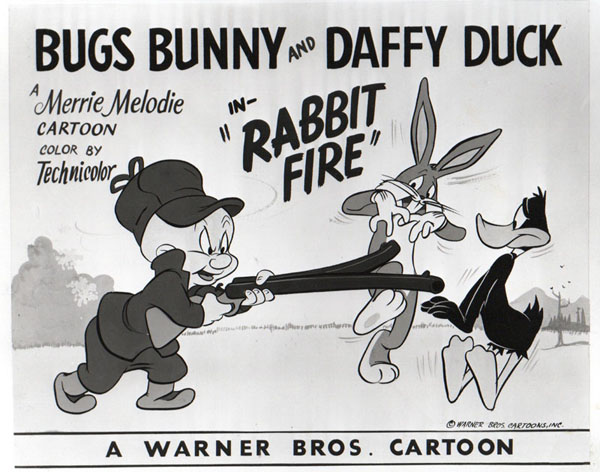
There are a number of iconic moments from classic cartoons, and Rabbit Fire has a lot of them.
This month marks the 75th anniversary of the first time Bugs Bunny, Daffy Duck, and Elmer Fudd began a feud in this Warner Bros. short that has gone down in the annals of animation history.
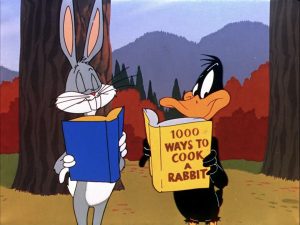 Rabbit Fire opens with one of those iconic moments, as Elmer Fudd carefully makes his way through the forest, shotgun in hand, and turns to the camera to inform the audience, “Be vewy vewy quiet, I’m hunting rabbits.”
Tracks lead to the rabbit hole of one “B. Bunny” (stated on his mailbox), but it turns out that Daffy Duck is making the tracks with a pair of fake rabbit feet.
Elmer tries to hunt Bugs who is trying to convince Elmer that he should instead be hunting Daffy, in the now iconic “Duck Season! Wabbit Season!” exchange between the two. This results in Daffy getting blasted by the shotgun and his bill being shifted in hilarious, precarious positions (more cartoon iconography).
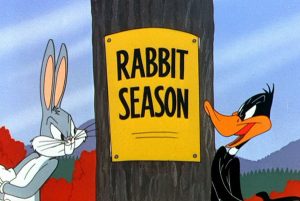
They dress up and imitate each other to throw Elmer off, and Bugs dresses in drag (another iconic gag used in this and future shorts) as a female hunter with Daffy as his dog. When Elmer eventually sees through this, Bugs and Daffy begin tearing “Rabbit Season” and “Duck Season” posters off a nearby tree (again, iconic), eventually revealing one that reads: “Elmer Season.”
With a vicious glare, the two turn the tables and begin hunting the hunter, ending the short by stating: “Be vewy, vewy quiet. We’re hunting Elmers.”
 Rabbit Fire came to be courtesy of the genius of two legends, who teamed up quite a bit at Warner Bros.: director Chuck Jones (billed here as “Charles M. Jones”) and writer Michael Maltese. Jones and Maltese created memorable sight gags, slowing the animation down for pauses, and allowing the audience to anticipate the laughs.
All of it delivered perfectly by Mel Blanc as Bugs and Daffy and Arthur Q. Bryan as Elmer.
In one sequence, Bugs tries to get Elmer interested in sports other than hunting, at which point, Daffy emerges, dressed in whites with a racquet in his hand, asking, “Anyone for tennis?” Elmer immediately shoots him, the smoke clears, and a scorched Daffy wearily declares, “Nice game!”
The comic timing in Rabbit Fire rivals anything seen in live action.
Adding to the brilliance of the short are backgrounds by Phillip DeGuard, and animation from Lloyd Vaughan, Ken Harris, Phil Monroe, and Ben Washam.
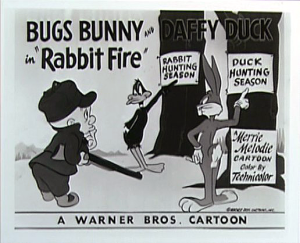 Following Rabbit Fire’s success, Bugs, Daffy, and Elmer teamed up again for two more short subjects, Rabbit Seasoning (1952) and Duck! Rabbit! Duck! (1953). Collectively, these cartoons have become referred to as “The Hunting Trilogy.”
The second of these, Rabbit Seasoning, came in at number 30 in our own Jerry Beck’s 1994 book, The 50 Greatest Cartoons. In it, author Joe Adamson notes: “The dialogue in these cartoons, savored by connoisseurs for years, was an element singled out for praise by Boxoffice as soon as the first of the trilogy appeared. Since Carl Stalling wrote the scores, there are now published pieces of music entitled ‘Rabbit Season,’ ‘Duck Season,’ ‘Elmer Season,’ and ‘Pronoun Trouble.’
The levels of irony, role-playing, role reversal, and slapstick that rebound, highlight, overlap, intensify, and ricochet off each other in all three of these cartoons have been the subject of endless analysis.”
Released on May 19, 1951, Rabbit Fire remains a shining moment in the Golden Age of Looney Tunes.